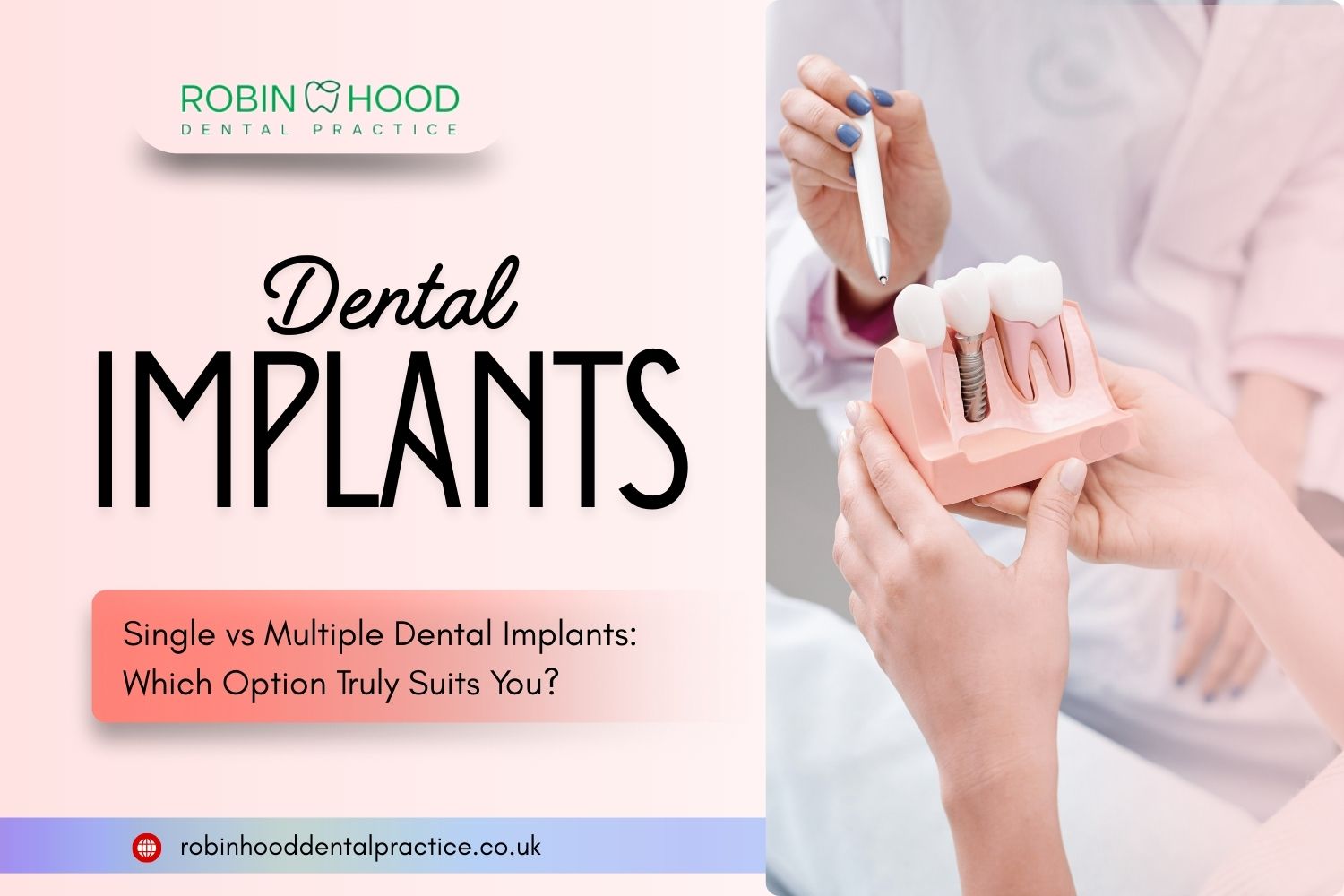
When people sit down in my surgery in Birmingham to talk about dental implants, the same worry comes up again and again. They'll say something like, "I've read about single implants and full mouth implants, but I honestly don't know what I actually need."
After more than twenty years of placing and restoring implants for patients across the UK, I can tell you that confusion is entirely typical. On paper, single dental implant treatment seems simple. In real mouths, with real biting habits and real budgets, it's a bit more nuanced. This piece walks you through how I genuinely think about single vs multiple dental implants when planning treatment — not from a sales angle, but from a long-term health point of view.
What Is a Single Dental Implant?
Put simply, a single implant is a one-to-one replacement for a missing tooth. We place a small titanium post into the jawbone where the root used to be. Over a few months, it fuses with the bone — a process called osseointegration — before we put a crown on top that looks and functions like a natural tooth.
In my experience, a single implant suits patients best when:
- There's just one tooth missing in an otherwise stable area
- The neighbouring teeth are healthy and don't need to be drilled for a bridge
- The gap is affecting your smile or your bite, but the rest of the mouth is pretty healthy
Most patients are surprised to learn that, once healed, they usually forget which tooth is on an implant. It simply behaves as part of the bite.
Pros in everyday life:
- It feels like you've "got that tooth back"
- You can chew on that side without worrying about a denture moving
- We don't have to involve the teeth on either side, which is a big plus if they're untouched
- It helps keep the bone in that area from slowly shrinking after extraction
Honest limitations: A single implant is excellent for one gap, sometimes two. But if you have three, four, or more missing teeth in the same region, doing one implant for every tooth isn't always the most sensible or comfortable option. That's where multiple dental implants come in.
What Are Multiple Dental Implants?
"Multiple implants" can mean two slightly different things:
- Several single implants in different places, each with its own crown
- A smaller number of implants supporting more teeth, such as an implant-supported bridge or a full arch
For example, if you've lost three teeth in a row, we might place two implants and link three crowns together on top, rather than placing three separate implants. For someone who has lost most of the teeth in an upper or lower jaw, we typically use 4–6 implants to support a complete set of fixed teeth.
This is something I see often in practice around Birmingham: patients have worn partial dentures for years, then reach a point where they want something more solid. In those cases, multiple dental implants supporting a bridge or full arch can be life-changing.
When dentists tend to recommend multiple implants:
- Several teeth are missing next to each other
- Heavily filled, failing teeth are more likely to cause trouble
- Long-standing denture wearers want a stable, fixed alternative
- The whole bite needs rebuilding, not just one gap filled
The idea is never "use as many implants as possible" — it's using the correct number in the right places to give stable, comfortable function.
Does It Matter If the Gaps Are Next to Each Other?
This is one of the biggest factors I weigh, and it's worth spelling out clearly:
- Consecutive gaps (missing teeth next to each other) are often better treated with an implant-supported bridge — fewer implants carrying several crowns — rather than one implant per gap. It's usually more efficient and, done well, just as stable.
- Non-consecutive gaps (missing teeth in different parts of the mouth) generally need to be treated as separate cases, each with its own implant, since there's no structural benefit to linking them.
- Missing more than roughly half the teeth in one arch is usually the point where a full-arch solution — sometimes called All-on-4, or a "full mouth" implant solution — starts to make more sense than replacing each gap individually. If this sounds like your situation, our full-arch implants guide covers that pathway in detail.
I mention this because a lot of patients assume the choice is purely "one implant per tooth" versus "not enough teeth for that" — in practice, the pattern of your gaps often matters as much as the number.
Single Implants vs Multiple Implants at a Glance
Patients often ask me, "Which is better?" The truth is, neither is better in every situation — they answer different problems.
Cost
Without getting into exact figures here, the general pattern I see:
- If you're replacing one tooth, a single dental implant is usually the most sensible and cost-effective choice
- If you're replacing several teeth, a well-planned bridge on a few implants can work out better value per tooth than placing an implant under every gap
- Prices also vary between practices because of training, materials, lab quality, and what's included (scans, temporary teeth, follow-up) — cheaper isn't always better if corners are cut on planning or aftercare
For a full, itemised breakdown of what a single implant costs at our Birmingham practice — including consultation, fixture, and crown options — see our dental implant cost guide. I often say to patients: it's not just the fee today; it's what that treatment is likely to look like and feel like in 10 years.
Time and Number of Appointments
A straightforward single implant usually involves: a planning visit and scan, implant placement, a healing period, then fitting the final crown.
Multiple implants — especially for a full jaw — naturally involve more planning and appointments. That said, you're dealing with several teeth at once, rather than treating one new problem every year.
Bone Considerations
This is a detail patients rarely hear discussed clearly: a single implant needs adequate bone at that one specific site. If bone has been lost — which happens naturally over time after a tooth is extracted — a bone graft may be needed first to rebuild a stable base. With multiple implants, there's sometimes more flexibility: we can often place fixtures in the areas of best bone density and use them to support teeth in weaker areas nearby, rather than needing strong bone at every single gap. This is one reason a multiple-implant plan can sometimes work where several individual implants wouldn't, and sometimes reduces how much grafting is needed overall.
Comfort and Function
Once you're healed, both options should feel very natural.
- A single implant tends to "disappear" into your bite; you simply use it
- A full arch or larger bridge on implants can feel like you've gone from cautious chewing to "I can eat normally again" — especially if you've lived with dentures for years
Long-Term Value
Dental implants have a strong success rate when placed in healthy bone and well maintained, and are generally viewed as a long-term tooth replacement rather than a quick fix. As with any surgical treatment, there's a small chance an implant doesn't integrate as expected or needs attention later — this is uncommon, and it's exactly why regular reviews matter, so anything can be caught and addressed early rather than left. In my experience, the patients who do best long term are those who choose a solution that aligns with their overall mouth health, not simply the lowest upfront price.
Who Isn't a Good Candidate Yet?
Implants aren't automatically right for everyone at the first visit — a proper assessment exists to catch this. Treatment is usually delayed, or an underlying issue treated first, if you have:
- Active gum disease — this needs treating before implant placement, since it affects how well the bone and implant will integrate
- Insufficient bone density — common after a tooth has been missing for a while; a bone graft can often resolve this, adding time to the plan
- Uncontrolled diabetes or certain other medical conditions — these can affect healing, so we'd work with you (and sometimes your GP) to get things stable first
- Heavy smoking — this measurably affects healing and long-term success rates, and it's worth an honest conversation about at your consultation
None of these rule implants out permanently in most cases — they usually just mean addressing the underlying issue first, which is exactly what your consultation and scans are for.
Which Option Is Right for You? (How I Actually Decide)
In the clinic, I don't start by asking "single or multiple?" I begin by looking at the whole picture.
Bone health — we need enough bone to hold the implants. If there's strong bone in a few key areas and less elsewhere, it sometimes makes sense to place fewer implants in the best sites and use them to support more teeth.
Bite and balance — I look at how your teeth come together, how you chew, and whether other teeth are likely to fail in the near future. One missing tooth in an otherwise healthy mouth points clearly to a single implant. Several heavily restored or cracked teeth suggest a bigger plan may be more sensible.
Lifestyle and expectations — if you're managing fairly well and simply fed up with one noticeable gap, a single implant is usually all you need. If you hate your dentures, avoid certain foods, or worry constantly that something will come loose, a more comprehensive approach might change your day-to-day life more.
Budget and timing — everyone has a budget. Sometimes we plan treatment in stages: a couple of single implants now, with options for more later if other teeth are lost. The important thing is that the plan is coherent, not a series of random "quick fixes."
A personal assessment is crucial — a proper examination, X-rays or scans, and a conversation about what you'd like to be able to eat and smile like again is where the correct answer usually becomes clear.
Already have a sense of which category you're in? Book a consultation and we'll confirm it properly with a proper exam and scan — no pressure, just clarity.
Common Patient Questions
Do multiple implants last as long as a single implant?
Assuming they're planned and placed well, and you keep your mouth healthy, both single and multiple implants can last many years. It's less about the number of implants and more about bone quality, your bite, your brushing habits, and regular reviews.
Is having multiple implants placed at once more painful?
Not necessarily. Whether we place one implant or several, the area is numbed, and you shouldn't feel pain during the procedure. Afterwards, if we've treated a larger area, you can feel a bit more swollen or bruised, but most patients manage very well with standard pain relief and good aftercare instructions.
Can I start with one implant and add more later?
Yes, and I see this quite often. We might replace the tooth that's bothering you most now, then monitor the rest of your teeth. If more are lost in future, we can discuss adding implants or using existing implants to support additional teeth, depending on how things have been planned.
Is an implant always better than a bridge for a single missing tooth?
For a single missing tooth, I tend to favour an implant where possible, because it doesn't require trimming the teeth on either side and it better supports the bone in that area. That said, there are times when a bridge is a perfectly reasonable choice — for example, if the neighbouring teeth already need crowns, or if you're not suitable for implants. It's not a one-size-fits-all rule.
How many implants do I need if I'm missing most of my teeth in one arch?
Once you're missing more than around half the teeth in an arch, individual implants for every gap usually stop being the most sensible approach. Most patients in this situation — sometimes searching for "full mouth" implant options — are better served by a full-arch solution using 4–6 implants — see our All-on-4 guide for how that works.
Why Seeing a Local Birmingham Implant Dentist Matters
If you live in or around Birmingham — Solihull, Sutton Coldfield, Edgbaston, Harborne, Moseley, and so on — seeing a local dentist for implants has a few convenient advantages:
- You've got someone nearby for reviews and maintenance — implants should be checked regularly
- If you ever feel something isn't right — tenderness, looseness, or you feel worried — you can be seen quickly
- It's easier to build a relationship over time, which matters for something as important as replacing missing teeth
In my view, continuity of care is just as important as the surgery itself. Implants are a long-term commitment, and it helps to have a team you can actually get to, not just a name on a website.
Final Thoughts — Taking the Next Sensible Step
Choosing between single dental implant treatment and multiple dental implants isn't something you should feel you have to figure out alone with a search engine. It's much easier once someone has properly examined your mouth, discussed your aims, and clearly shown you your options.
If you're in the Birmingham area and unsure which way to go, the most useful next step is a straightforward consultation — no pressure, just an honest look at where things are now and what's realistically possible. From there, we can work out a plan that fits your mouth, your lifestyle, and your budget — whether that's one implant, several, or a staged approach over time.
Book a consultation or see our dental implant cost guide for exact Birmingham pricing.