Root Canal vs Emergency Extraction: Which Is Right for You?
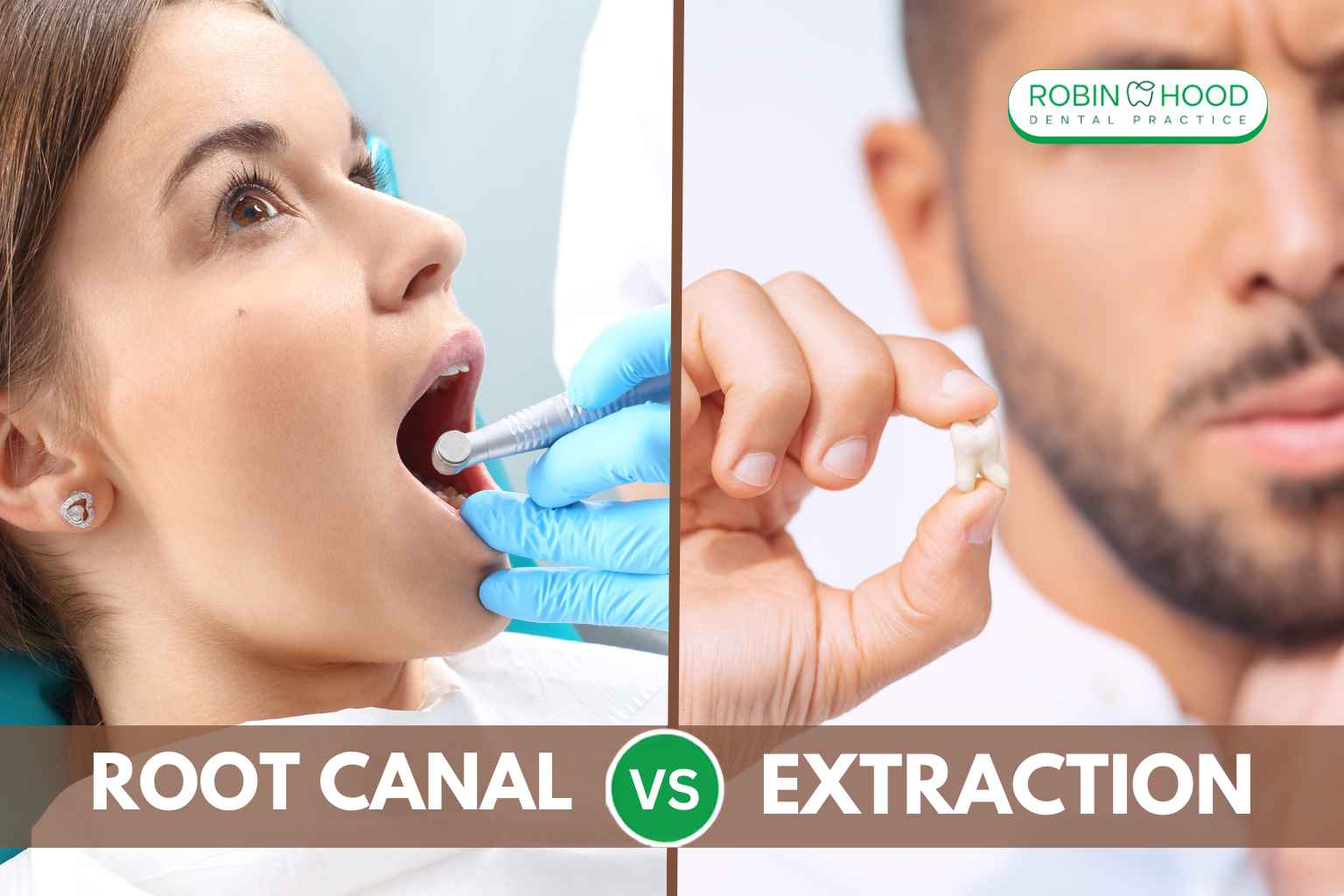
Bad tooth pain rarely waits for a convenient time, and once a dentist tells you the tooth needs treatment, there are usually two paths on the table: save it with a root canal, or take it out. Neither decision should be made on pain alone — an X-ray and a proper assessment are what actually determine which route is realistic for your specific tooth. This guide sets out what each option actually involves, what it costs at Robinhood Dental Practice, and the questions worth asking before you decide.
Root Canal vs Extraction: The Short Version
A root canal removes the infected or damaged pulp inside a tooth and keeps the tooth itself in place. An extraction removes the whole tooth. As a general rule, dentists will try to save a natural tooth wherever it's realistically possible — replacing a missing tooth later, with an implant, bridge, or denture, usually involves additional treatment, appointments, and cost compared with treating the original tooth would have.
The question that actually drives this decision, more than pain or how the tooth looks, is restorability — can the tooth be rebuilt into something that will function properly once the infection or damage is dealt with? A tooth can be restorable even with significant decay, as long as enough healthy structure remains for a root canal and crown to hold. It becomes unrestorable when the damage — a crack running below the gum line, a fracture splitting the root, or decay that's destroyed too much of the tooth — leaves nothing solid enough to build on. Restorable generally points towards root canal; unrestorable generally points towards extraction.
| Factor | Root Canal | Extraction |
|---|---|---|
| Goal | Save the natural tooth | Remove the tooth entirely |
| Typical appointments | 1–2 visits | Usually 1 visit |
| Robinhood Dental price | £395–£595 depending on tooth, £950 for retreatment | From £110, up to £195 (unless surgical/wisdom tooth) |
| During the procedure | Numbed throughout — no pain | Numbed throughout — no pain |
| Recovery | Mild soreness, 1–3 days | Soreness and swelling, 7–10 days |
| Long-term result | Tooth preserved, usually needs a crown after | Gap left — replacement worth discussing |
| Natural tooth | Preserved | Removed |
| Need for replacement | Usually no | Worth considering — implant, bridge, or denture |
| Main risk | Reinfection, or fracture if left uncrowned | Dry socket, or infection if the socket isn't kept clean |
| NHS availability | Yes — Band 2 (£76.60) | Yes — Band 2 (£76.60) |
How a Root Canal Actually Works
Root canal treatment — endodontic treatment, if you want the clinical term — treats infection or damage inside the tooth's pulp while leaving the outer structure of the tooth in place. It's the right call when decay or injury has reached the tooth's core but the tooth itself is still structurally sound enough to build on.
The process, step by step:
- Assessment and X-ray to confirm the extent of the infection and check the root shape
- Local anaesthetic, so nothing hurts during the procedure
- The infected pulp is removed from inside the tooth
- The root canal is cleaned, shaped, and filled to seal it against reinfection
- A crown is usually fitted afterwards to protect and strengthen the treated tooth
Most cases take one to two appointments of roughly 60–90 minutes each, and a general dentist handles the majority of them — complex cases, such as unusually curved roots or a previous failed root canal, are sometimes referred to a specialist endodontist. Root canal treatment is generally considered highly successful when the tooth is genuinely restorable and the procedure is followed by a properly fitted crown, though as with any dental treatment, no outcome can be guaranteed.
How an Emergency Extraction Actually Works
An extraction removes the tooth entirely, and it's the option when the tooth is too damaged, decayed, or fractured to realistically save. It's also the faster route to pain relief when an infection or abscess needs resolving urgently.
The process:
- A quick assessment and X-ray confirms exactly what's going on and whether the extraction will be simple or surgical
- Local anaesthetic fully numbs the tooth and surrounding area
- The tooth is loosened and removed — simple extractions use forceps for a visible, intact tooth; surgical extractions involve the gum (and sometimes bone) for impacted or broken teeth
- Gauze is placed over the socket, and stitches are added if the extraction was surgical
Extraction offers a definitive way to remove a tooth that genuinely can't be saved, and same-day appointments are widely available for exactly that kind of urgent situation. It's worth knowing, though, that a root canal can also resolve the source of infection while keeping the tooth in place — extraction being quicker on the day doesn't automatically make it the better long-term choice if the tooth is actually restorable.
How Does a Dentist Actually Decide?
The decision isn't made from a single symptom — it comes from weighing several things together, usually in this order:
- X-ray findings — the clearest picture of root shape, bone support, and how far any infection has spread
- How much healthy tooth structure remains — the basis for whether the tooth is restorable
- Whether there's a crack or fracture, and where it sits — particularly whether it extends below the gum line
- How far any infection or abscess has spread — contained versus affecting the surrounding bone
- Bone and gum support around the tooth — a tooth with little bone left to anchor it is a weaker long-term bet even if the crown itself could be saved
- Your general health and any relevant medical history
- Your own preference, once you understand what's realistically achievable either way
When the Tooth Is an Abscess, a Crack, or Already Dead
Three situations come up often enough to be worth addressing directly, and restorability is the thread running through all of them.
An abscess — a pocket of infection at the root — doesn't automatically mean extraction. If the tooth structure above the infection is still sound, a root canal can clear the infection from inside the tooth while keeping it in place. Antibiotics alone won't resolve this, since they don't remove the source; they can calm things down temporarily, but the infection tends to return once the course finishes. Extraction becomes the more realistic option when the abscess has caused enough bone loss around the root that the tooth wouldn't have a stable foundation even after treatment.
A cracked or broken tooth comes down to where the crack sits and how far it runs. A crack confined to the crown, above the gum line, can often be treated with a root canal and rebuilt with a crown. A crack that extends below the gum line, or a vertical fracture running down through the root, usually can't be sealed reliably — bacteria keep finding a way back in — and extraction is generally the more predictable outcome.
A "dead" or non-vital tooth — one where the nerve inside has died, often after an old injury or deep decay — isn't necessarily a lost cause. If the surrounding structure is intact, a root canal removes the dead tissue and the tooth can function normally afterwards, often without you noticing any difference. It only points towards extraction if the tooth itself has also become structurally unsound.
What About Wisdom Teeth?
Wisdom teeth are something of an exception to "always try to save it first." They're often extracted rather than treated with a root canal, and not because dentists give up on them more easily — it's because of where they sit. Wisdom teeth are frequently impacted or only partially erupted, genuinely difficult to keep clean even with good habits, and prone to repeated infection around the gum flap that covers them. They can also crowd or damage the tooth next to them. A wisdom tooth that's fully erupted, straight, and causing no problems doesn't need to come out just because it's a wisdom tooth — but one that's impacted and causing recurrent trouble is usually a more straightforward case for extraction than for root canal treatment.
When Root Canal Is the Right Call
A root canal makes sense when the tooth's structure is still largely intact and the infection is contained to the pulp. It's particularly worth pursuing when the tooth is somewhere visible — a front tooth, for instance — where losing it would mean a replacement conversation anyway, or when there's no fracture reaching below the gum line.
Signs your tooth is likely still saveable: mild swelling rather than severe, sensitivity to hot or cold that comes and goes, lingering discomfort after a recent filling, or an X-ray showing pulp inflammation without significant bone loss around the root. None of these are a guarantee — only your dentist can confirm from the X-ray — but they're the kind of picture where saving the tooth is usually realistic.
When Extraction Is the Right Call
Extraction becomes the more sensible option when a tooth is cracked below the gum line, too decayed to rebuild, or when infection has already spread beyond what cleaning and filling the root canal could resolve. A previously failed root canal, an impacted wisdom tooth, or advanced gum disease with significant bone loss around the tooth all point the same direction.
Some symptoms mean the conversation needs to happen today rather than this week: swelling spreading across the face or jaw, a fever, pus draining from the gum, or difficulty swallowing or breathing. Any of those is a same-day dental or emergency department situation, not something to sit with overnight.
Cost Comparison
NHS treatment for both options falls under Band 2, a fixed £76.60 covering the procedure regardless of which tooth is involved. Privately, at Robinhood Dental Practice, root canal treatment runs £395 for an incisor, £495 for a premolar, or £595 for a molar, with retreatment priced at £950. Extractions start from £110, up to a maximum of £195, unless a surgical or wisdom tooth extraction is needed, which is priced individually after assessment. For the full breakdown of what affects each price, see our complete guides to root canal costs and tooth extraction costs.
It's worth thinking beyond the headline number, though. An extraction that isn't replaced can lead to bone loss, shifting teeth, and bite changes over time — and replacing a missing tooth later typically involves additional cost. That doesn't mean extraction is the wrong call when it's genuinely needed — sometimes it's the only realistic option — but it's a reason to look at the full total rather than just the procedure price on its own.
The Real Total: Root Canal vs Extraction Plus Replacement
The procedure price alone doesn't tell the full story, because a root canal usually needs a crown afterwards, and an extraction — if you choose to replace the gap — needs an implant, bridge, or denture. Here's what each route actually adds up to at Robinhood Dental Practice:
| Route | What It Includes | Total Cost |
|---|---|---|
| Root canal + crown | Root canal (£395–£595) + crown (£495–£695) | £890 – £1,290 |
| Extraction only, no replacement | Extraction (£110–£195) | £110 – £195, plus the long-term cost of bone loss and drift |
| Extraction + denture | Extraction (£110–£195) + acrylic denture (£495) | £605 – £690 |
| Extraction + implant | Extraction (£110–£195) + implant fixture (£2,500) + crown (£495–£695) | £3,105 – £3,390 |
Seen this way, a root canal is very often the cheaper route once you account for what comes after extraction — not just cheaper than an implant, but frequently cheaper than a denture too, while also being the only option that keeps your natural tooth. Extraction without any replacement looks like the lowest number on paper, but it's the option most likely to cost you more later, once bone loss and shifting teeth start affecting neighbouring work. Implant costs vary between practices depending on what's included in the quoted price, so it's always worth checking exactly what's covered when comparing figures — at Robinhood Dental, the £2,500 fixture price and crown cost are itemised separately so there's nothing hidden in the total.
Pain and Recovery Compared
During either procedure, local anaesthetic means you shouldn't feel pain — that part is genuinely similar between the two. The difference shows up afterwards.
Root canal recovery is usually mild: soreness for one to three days, manageable with over-the-counter pain relief, and most patients are back to normal within a few days while waiting for the follow-up crown appointment. Extraction recovery involves more noticeable soreness and swelling for around seven to ten days, and carries a small risk of dry socket — a minority of cases, though estimates vary — where pain that should be easing instead spikes again a few days in. Ibuprofen for inflammation, a cold compress against the cheek, and sticking to soft food in the first few days help with both.
Long-Term Effects on Your Oral Health
A root canal keeps the tooth, and with it the jawbone and bite stability that depend on having a full set of teeth doing their job. An extraction that isn't replaced leaves a gap that doesn't just sit there quietly — the jawbone beneath it begins to resorb, commonly cited at around 25% of bone volume in the first year alone, and neighbouring teeth can gradually drift into the space. Over time this can affect your bite and, in some cases, the shape of your face.
None of this means extraction should be avoided when it's genuinely the right call — sometimes it is. It's simply why dentists tend to default to saving a natural tooth wherever that's realistic, and why replacement is worth discussing before you leave the chair if extraction is the outcome.
What Robinhood Dental Recommends
"My starting position with every patient is the same: can we save this tooth? Extraction is never the first conversation — it's what we discuss once an X-ray shows saving the tooth genuinely isn't realistic. Patients sometimes assume extraction is the simpler or cheaper option, and while it can look that way upfront, it's rarely the better one long-term if the tooth can be saved," says Dr Mudasir Ur Rehman, GDC No. 196599, at Robinhood Dental Practice.
In practice, the decision comes down to the X-ray findings, how far any infection has spread, your general health, and — once you understand the realistic options — your own preference. If you're ever unsure whether extraction is really the only option, asking for a second opinion is entirely reasonable.
Can You Get Either Treatment the Same Day?
Same-day extraction is widely available, including at Robinhood Dental Practice, which is open seven days a week for exactly this kind of urgent situation. Same-day root canal treatment is possible but less common, since more complex cases may need a specialist — if you're in pain and unsure which applies to you, the fastest route is simply to call and describe what's going on.
Frequently Asked Questions
Is it better to have a root canal or get the tooth pulled?
A root canal is the better option whenever the tooth can genuinely be saved, since it keeps your natural tooth and avoids the knock-on costs and bone changes that come with a gap. Extraction is the right call once the tooth is too damaged, cracked, or infected for a root canal to realistically fix.
What happens if I don't replace an extracted tooth?
The teeth around the gap gradually drift into the space, the jawbone beneath it starts to shrink, and over time this can affect your bite and, in some cases, the shape of your face. It doesn't happen overnight, but it's worth discussing replacement options with your dentist before you leave the appointment.
How do I know if my tooth needs a root canal or an extraction?
Pain alone doesn't tell the full story, so this isn't something to diagnose at home. Your dentist needs to examine the tooth and take an X-ray. If the root structure is sound and the problem is contained infection, there's usually a good chance the tooth can be saved. Significant cracks or structural damage below the gum line are usually when extraction becomes the realistic conversation.
Is root canal treatment available on the NHS?
Yes, under Band 2 treatment, which costs £76.60 in England. The main limitation is appointment availability — NHS dental slots can be hard to come by in many areas, which is why private treatment, from £395 at Robinhood Dental, is often the faster route if you're in pain and need treatment soon.
Can a tooth infection go away without any treatment?
No, and waiting it out is genuinely risky. Antibiotics can ease symptoms temporarily, but they don't resolve the underlying infection, which tends to return once the course finishes — sometimes worse than before. In serious cases, infection can spread to the jaw or, rarely, into the bloodstream. It's worth getting checked early rather than waiting to see.
How long does a root canal last?
Most root canals last 10–15 years or longer with a properly fitted crown and regular check-ups, and many last a lifetime with good care.
Is extraction cheaper than a root canal?
Upfront, usually yes — extraction at Robinhood Dental starts from £110 versus £395 and up for a root canal. Factor in a replacement tooth later, though, and the total cost of extraction often ends up higher than treating the original tooth would have been.
Can a root canal fail?
Yes, though it's uncommon when the tooth was genuinely restorable to begin with. Reinfection, a missed canal, or a crack developing afterwards can all cause a root canal to fail. Retreatment is usually possible in these cases, priced at £950 at Robinhood Dental.
Do I always need a crown after a root canal?
Usually, yes, particularly on back teeth. A root canal removes the pulp that kept the tooth nourished, which leaves it more brittle over time — a crown protects it from cracking under normal biting pressure.
Book a Same-Day Assessment in Birmingham
If you're in pain and unsure whether your tooth can be saved, don't wait it out — an X-ray is what actually answers the question, not guessing based on how it feels. Dr Mudasir Ur Rehman, GDC No. 196599, and the team at Robinhood Dental Practice offer same-day appointments for exactly this kind of decision, seven days a week at 1491 Stratford Road, Hall Green, Birmingham B28 9HT. Call 0121 744 1484 to get seen today.
Medical disclaimer: This article is for general information only and does not replace personalised advice from a qualified dentist. Every tooth and every patient is different — if you're concerned about your own situation, please contact your dental practice directly.