Last updated: October 22, 2026
Quick answer: when is it time to book a check-up?
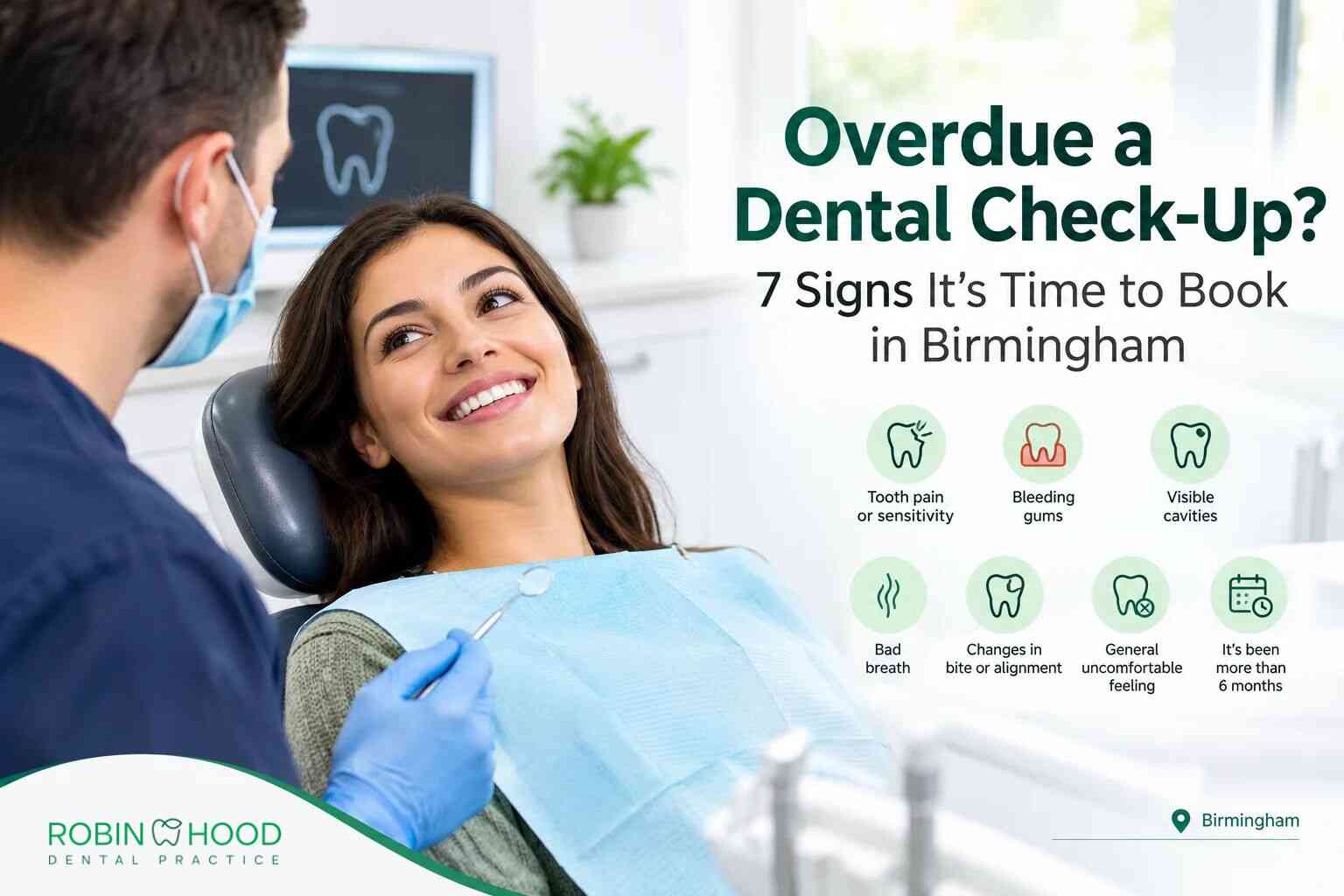
You are overdue if you have passed the recall date your dentist gave you, or if it has been more than two years, which is the longest gap NICE recommends for adults. Book sooner if your gums bleed when you brush, one tooth keeps reacting to hot, cold or sweet things, your breath stays unpleasant despite careful cleaning, a tooth feels rough or looks different, your jaw aches when you wake, or a mouth ulcer or patch hasn’t healed in three weeks. None of these normally needs an emergency appointment. All of them are cheaper and simpler to deal with before they hurt.
| What you notice | How soon to book | Why it matters |
|---|---|---|
| Gums bleed when you brush or floss | Within a few weeks | Early gum disease (gingivitis) can be reversed; the later stage (periodontitis) cannot |
| Sensitivity that keeps returning to the same tooth | Within a few weeks | Often early decay, worn enamel or a receding gum |
| Bad breath or a bad taste that won’t clear | Within a few weeks | Often linked to gum disease or decay in places a brush can’t reach |
| A rough edge, chip or darker tooth | Within a week or two | A broken edge can trap plaque, and a colour change can mean the inside of the tooth is affected |
| Sore jaw or headache on waking, flattened or cracked teeth | Within a few weeks | Possible teeth grinding |
| Mouth ulcer, red or white patch, or lump lasting over 3 weeks | As soon as you pass the three-week mark | NHS advice is to have it checked by a dentist or GP |
| No idea when you last went | Now | Early dental problems are often painless |
| Constant pain, facial swelling, fever or a knocked-out tooth | Today | This is urgent, not a check-up: see our emergency dentist guide or call 0121 744 1484 |
If swelling is making it hard to breathe or swallow, call 999 or go to A&E.
How often do you actually need one?
Not automatically every six months. NICE guidance on dental recall says the gap between check-ups should be set for each person after a risk assessment: anywhere from 3 to 24 months for adults, and 3 to 12 months for under-18s. A large NIHR-funded trial (INTERVAL) followed more than 2,000 adults for four years and found no evidence of a difference in oral health between six-monthly and risk-based check-ups. The same was true of 24-month check-ups for the people their dentist had judged suitable for the longer gap.
The catch is in the last part of that sentence: the long interval is for people who have repeatedly shown they can keep their mouth healthy. Your own interval is likely to be shorter if you:
- have had decay, fillings or crowns in recent years
- have gum disease or bleeding gums
- smoke or vape
- have diabetes or a dry mouth
- eat or drink sugary things often through the day
Two things follow from this. First, ask your dentist what interval suits you and why, because it can change over time. Second, symptoms override the schedule. If any of the signs below appears, book now, whatever your recall date says. For more on how often to go and what regular visits achieve, see our guide to the benefits of regular dental appointments.
The 7 signs, and what each one usually means
1. Your gums bleed when you brush or floss
Healthy gums don’t bleed. Bleeding usually means plaque along the gumline has inflamed the gum, which is gingivitis. It is often painless, which is why people ignore it. At this stage it can be reversed with proper cleaning. Left alone, it can progress to periodontitis, which damages the bone that holds teeth in place and can’t be reversed, only controlled.
What to do: book an examination. If you also notice gums pulling back, teeth looking longer or a tooth feeling slightly loose, say so, because that points beyond the early stage. A professional hygiene appointment (from £64.50 at Robinhood) removes the plaque and tartar you can’t shift at home. Brushing can cause some bleeding when you first clean thoroughly, but it should settle within days as the inflammation calms.
2. One tooth keeps reacting to the same thing
A stray twinge now and then isn’t unusual. A tooth that repeatedly zings with cold drinks, sweets or hot tea is pointing at a problem. Common causes are early decay, enamel worn thin, a gum that has receded to expose the softer root surface, or a small crack.
What to do: have the tooth looked at and X-rayed. A small area of decay is usually a straightforward filling. A desensitising toothpaste can ease symptoms in the meantime, but it won’t find or fix the cause.
3. Bad breath or a bad taste that doesn’t go away
Morning breath, coffee and garlic don’t count. Breath that stays unpleasant despite brushing, cleaning between your teeth and rinsing often has a cause in the mouth itself: gum disease, trapped plaque, or decay in a spot your brush doesn’t reach. Mints and mouthwash cover the smell for an hour but leave the source in place.
What to do: book a check-up and ask the dentist to look specifically at your gums and between your teeth. If the mouth is healthy, they can point you towards other causes, such as dry mouth or smoking.
4. A rough edge, a chip, or a tooth that has changed colour
Your tongue is good at noticing a new sharp or rough spot. A chip can look cosmetic, but a broken edge holds plaque and can cut your tongue or cheek. A tooth that has gone darker than its neighbours can mean the nerve inside has been damaged, sometimes after a knock you’d forgotten about, and it can be painless.
What to do: book within a week or two. Depending on the damage, repairs range from composite bonding or a filling to a crown. If the tooth hurts, is loose, or has been knocked out, treat it as urgent and call us on 0121 744 1484.
5. A sore jaw, headaches on waking, or teeth that look worn
Clenching and grinding are often linked to stress or anxiety, and most people who do it don’t realise. Clues include a stiff jaw in the morning, pain around the face or ear, worn or flattened teeth, cracked fillings, sensitive teeth, or a partner who hears grinding at night.
What to do: NHS advice is to see a dentist if you have any of these, particularly with tooth damage or jaw pain. Treatment isn’t always needed, but if your teeth are being worn down, a night guard can protect them. A night guard is available from £195 at Robinhood.
6. A mouth ulcer, patch or lump that has lasted three weeks
Most mouth ulcers are harmless and heal within a couple of weeks. The NHS advice is to have an ulcer checked by a dentist or GP if it lasts longer than three weeks, and to do the same for a red or white patch, a lump in the mouth or on the lip, or pain in the mouth that isn’t going away. Early checks matter because mouth cancer is easier to treat when found early.
What to do: don’t wait for your next routine visit. Book as soon as you pass three weeks. A dentist can examine the area and refer you on if needed. Having a symptom doesn’t mean you have cancer, and most of these turn out to be something minor.
7. You can’t remember your last check-up
This is the sign with no symptoms at all, and it’s the most common one. Decay and early gum disease are usually painless, and pain tends to arrive late, when the problem is bigger. If it has been more than two years, or you don’t know, you’re past the longest gap NICE recommends for adults.
What to do: book an examination. At Robinhood Dental Practice, a new patient examination is from £25 and an X-ray from £10. If it has been years, the next section explains what to expect.
Haven’t been for years? What to expect
If it has been several years, you are far from alone, and it is not too late. Dentists see long gaps regularly, and an examination is about finding out where things stand, not judging how you got there. Plenty of people in the UK have gone years without a check-up because they couldn’t find an NHS dentist, or because cost or nerves got in the way.
A first visit after a long gap usually goes like this:
- A fuller look. The dentist examines your teeth, gums and the soft tissues of your mouth. X-rays may be recommended, because they show decay between teeth and under fillings that the eye can’t see.
- Your gums may need attention. After a long gap, plaque and tartar build-up and gum inflammation are common, and your gums may bleed more at first. That is a sign they are inflamed, not a reason to stay away. A hygiene appointment may be suggested.
- A plan in order of priority. Anything painful or likely to get worse quickly comes first. Your dentist will tell you what is urgent and what can safely wait, so you don’t have to fix everything at once.
- A price before any treatment. You get a quote for your own teeth after the examination, before treatment begins.
The first step is the smallest cost: an examination from £25, plus £10 for an X-ray. Private fees are not regulated, so they vary. The published fee guides of five Birmingham private practices we reviewed list routine check-ups from £35 to £60 and new-patient examinations from £75 to £91, and some of those include X-rays. NHS Band 1 is £27.90 in England, but not everyone can find an NHS dentist, so whichever practice you choose, ask for the price of the first appointment before you book.
What waiting costs: the price ladder
A molar root canal plus the cheapest crown on our price list is £1,090. An examination and X-ray, which is how decay is usually found while a filling is still an option, is £35. Dental problems rarely get cheaper with time, and each step below costs more than the one before it.
| Step | What’s involved | Robinhood price from |
|---|---|---|
| 1. Check | New patient examination, plus an X-ray | £25 + £10 |
| 2. Early decay | Filling: glass ionomer / amalgam / composite | £80 / £150 / £175 |
| 3. Decay reaches the nerve | Root canal: incisor / premolar / molar | £395 / £495 / £595 |
| 4. Tooth needs protecting | Crown: metal / porcelain fused to metal / zirconia or Emax | £495 / £595 / £695 |
| 5. Tooth can’t be saved | Extraction (surgical and wisdom teeth are quoted separately) | £110 to £195 |
| 6. Replacing the tooth | Acrylic denture, or a dental implant | £495, or £2,500 |
Not every problem climbs the ladder. Many fillings last for years, and a check-up sometimes finds something that needs a root canal anyway. Some problems skip steps altogether, such as a cracked tooth or an injury. What changes with time is the odds: the earlier a dentist sees a problem, the more likely it is to sit on step 2 rather than step 4.
These are “from” prices. You get a quote for your own tooth after the examination, before any treatment starts.
What happens at a check-up
A check-up is a look and a conversation, not a procedure. The dentist asks about symptoms and your medical history, examines your teeth, gums, fillings and the soft tissues of your mouth, takes X-rays only if needed (from £10), and gives you advice and a recommended date for your next visit. If treatment is needed, it is explained with the cost before anything starts. If you are new to the practice, our guide to your first visit to Robinhood Dental Practice walks through the whole appointment.
If you’re nervous about going
Many people put off a check-up because of anxiety, and dentists see this every day. Tell the team when you book so they can plan the appointment around you, ask them to explain each step, and agree a signal, such as raising your hand, that means stop. Your first visit can be just a look and a talk. We’re open until 10:00pm on weekdays and until 8:00pm at weekends, so you can pick a time that suits you.
Children
NHS advice is to take a child to the dentist once their first milk teeth appear, then for regular check-ups at the interval the dentist recommends. NICE guidance sets that interval between 3 and 12 months for under-18s. A first visit is often just a look and a chat, which helps children get used to the chair. NHS dental care is free for children in England, wherever it is provided. Call us on 0121 744 1484 to ask what we offer for your child and what it costs.
Dental check-up FAQs
How often should I have a dental check-up?
Adults are usually advised anywhere from every 3 months to every 2 years, depending on their risk of dental disease. Many healthy adults go every 6 to 12 months. For under-18s the range is 3 to 12 months. Your dentist sets your interval at the examination.
How do I know if I’m overdue a dental check-up?
You are overdue if you have passed the recall date your dentist gave you, or if it has been more than two years, which is the longest gap NICE recommends for adults. If you have symptoms such as bleeding gums or a tooth that keeps reacting, book now whatever your recall date says.
What happens if I haven’t been to the dentist for years?
It is not too late. The dentist will examine your teeth, gums and soft tissues, may recommend X-rays, and give you a plan in order of priority with a price before any treatment starts. Early gum disease can still be reversed, and decay found now is usually simpler to treat than decay found later.
Do I need a check-up if nothing hurts?
Yes. Decay and early gum disease are often painless, so a check-up with no symptoms is when problems are found at their cheapest and simplest stage.
Are bleeding gums normal?
No. Healthy gums don’t bleed. Bleeding usually means gum inflammation (gingivitis), which can be reversed if treated. If it carries on after a few days of thorough cleaning, book an examination.
How much is a dental check-up in Birmingham?
At Robinhood Dental Practice in Hall Green, a new patient examination is from £25 and an X-ray from £10, so an examination with an X-ray starts at £35. For comparison, NHS Band 1 is £27.90 in England from 1 April 2026 and covers an examination, X-rays if needed and advice. Private fees are not regulated, so they vary between practices.
How much will it cost if I haven’t been for years?
The first step is the examination, from £25 at Robinhood, plus £10 for an X-ray. Any treatment is quoted for your own teeth after the examination and before it starts, so you decide what to go ahead with.
Is a check-up the same as a hygiene appointment?
No. A check-up is an examination by the dentist. A hygiene appointment is a professional clean by a hygienist, which removes plaque and tartar you can’t shift at home. Hygiene appointments start at £64.50 at Robinhood.
What’s the difference between a check-up and an emergency appointment?
A check-up is a planned, routine look. An emergency appointment is for constant pain, facial swelling, fever or a knocked-out tooth, which can’t wait. If you aren’t sure which you need, ring and describe your symptoms. If swelling makes it hard to breathe or swallow, call 999 or go to A&E.
Book a check-up in Hall Green
If any of these signs sound familiar, or you can’t remember your last visit, book an examination at Robinhood Dental Practice, 1491 Stratford Rd, Hall Green, Birmingham, B28 9HT. Book online, call 0121 744 1484, or message us on WhatsApp on 0782 783 4763. We welcome new patients.
We’re open Monday to Friday 8:30am to 10:00pm, Saturday 8:30am to 8:00pm and Sunday 9:00am to 8:00pm. If you have constant pain, facial swelling, fever or a knocked-out tooth, don’t wait for a check-up slot: call us today, or NHS 111 outside our opening hours.
Sources
- NICE: Dental checks, intervals between oral health reviews (CG19)
- NIHR Evidence: Dental check-ups every six months unnecessary for people at low risk
- British Dental Journal: the INTERVAL dental recalls randomised controlled trial
- NHS: Mouth ulcers
- NHS: Teeth grinding (bruxism)
- SDCEP: Information about gingivitis
- Health for Kids: Registering with a dentist
- NHS: NHS dental charges from 1 April 2026
- Robinhood Dental Practice: prices and opening hours
This guide is general information, not a diagnosis or a substitute for advice from a dentist. If you’re unsure how urgent a problem is, call NHS 111. In a life-threatening emergency, call 999.