Last updated: August 21, 2026
Quick answer: A tooth abscess is a pocket of pus caused by a bacterial infection in the tooth or gum. It will not go away on its own, and antibiotics alone cannot cure it — the pus has to be drained and the source of the infection removed, usually through root canal treatment or extraction. Most cases are urgent but manageable with same-day dental care. A smaller number progress to facial swelling, fever, or breathing and swallowing difficulty, which needs emergency medical attention rather than a routine appointment.
If you're reading this because your face has started swelling or you're struggling to swallow, skip ahead to when it's an emergency. If you're trying to work out whether that dull throb is "just sensitive" or something worse, start from the top.
What Is a Tooth Abscess?
A tooth abscess forms when bacteria get inside a tooth or under the gum and your immune system walls off the infection, creating a pocket of pus. It's not the infection itself you feel throbbing — it's the pressure of pus building up against nerve-rich tissue with nowhere to escape, which is why abscess pain is often described as worse than ordinary toothache.
There are two distinct types, and knowing which one you're dealing with changes what treatment looks like:

| Periapical abscess | Periodontal abscess | |
|---|---|---|
| Where it forms | At the root tip, inside the bone | In a gum pocket beside the tooth |
| Usual cause | Decay or a crack reaching the nerve | Gum disease trapping bacteria in a pocket |
| Tooth condition | Often decayed, cracked, or previously filled | Can be structurally healthy |
| Typical history | A cavity, a heavily filled tooth, or a knock to the tooth | Existing gum disease — bleeding gums, looseness, recession |
A practical way to tell them apart before you even see a dentist: periapical abscesses tend to follow a history of a filling, a cracked tooth, or untreated decay in that specific tooth. Periodontal abscesses tend to show up in people who already have looser teeth, receding gums, or bleeding when they brush — the infection is tracking gum disease that was already there.
If the tooth in question is a wisdom tooth, the presentation is often slightly different — swelling under the gum flap and difficulty opening the mouth are more common than a classic root-tip abscess. That's covered in more depth in our wisdom tooth pain guide, including pericoronitis, which is the infected-flap version of this problem specific to partially erupted wisdom teeth.
Tooth Abscess Symptoms
Symptoms depend on how established the infection is. Early on they can be subtle enough to dismiss; once pus has fully collected, they're hard to ignore.
| Early / mild | Established / advanced |
|---|---|
| Sensitivity to hot or cold that lingers after the trigger is gone | Constant, throbbing pain that keeps you awake |
| Mild tenderness when biting down | Sharp pain when biting or touching the tooth |
| A faint bad taste or breath | Persistent foul taste, often with visible pus |
| Slight puffiness in the gum | Visible swelling of the gum, cheek, or jaw |
| No systemic symptoms | Fever, fatigue, swollen glands in the neck |
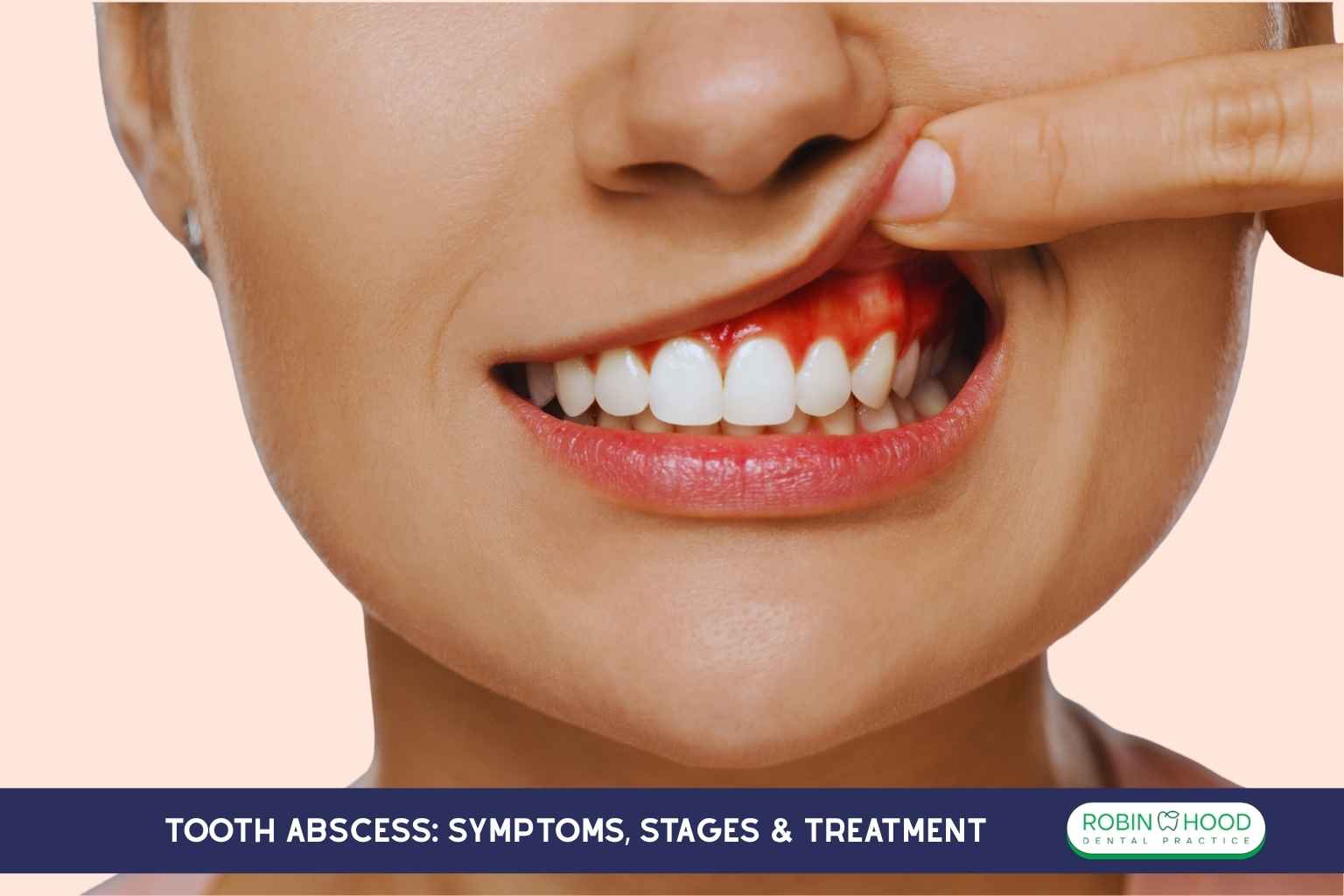
One symptom worth knowing about specifically: a small, pimple-like bump on the gum, sometimes called a dental fistula or "gum boil." This is a drainage channel your body has formed to relieve the pressure. If it starts leaking, the pain often eases dramatically within hours — which understandably makes people think the problem has resolved. It hasn't. The infection is still there; it's just found an escape route. The tooth still needs treatment, and the fistula can recur or worsen without it.
This is one of the most common patterns we see in practice: someone comes in with a painful swelling, it drains on its own overnight, the pain drops from a 9 to a 2, and they cancel the appointment they'd booked because it "feels better now." A few weeks later they're back — same tooth, worse swelling, sometimes with a fever this time — because the underlying decay or crack that caused the infection was never actually treated. A quiet fistula is not a resolved abscess.
Where a fistula has been present for a while or keeps recurring, we'll sometimes trace it with a small radiopaque marker (gutta-percha) during the X-ray, so the drainage channel shows up on the image and points straight back to the tooth it's coming from. This is particularly useful when a fistula sits some distance from the tooth actually causing it, which happens more often than people expect.
The Stages of a Tooth Abscess
Most patient-facing guides describe symptoms as a flat list. In practice, a tooth abscess develops in a fairly predictable sequence, and knowing where you sit on it helps you judge urgency more accurately than symptom-spotting alone.

Stage 1: Silent decay
Bacteria have breached the enamel and dentine but haven't yet reached the nerve. There may be no pain at all, or just occasional sensitivity to sweet food. This is the stage where a routine check-up and a filling would have prevented everything that follows — which is exactly why six-monthly reviews matter more than they get credit for.
Stage 2: Pulpitis
Bacteria reach the pulp (the nerve and blood supply inside the tooth). Pain becomes noticeable — often a sharp reaction to hot or cold that lingers. At this point the pulp is inflamed but not yet dead. Root canal treatment here has the best chance of saving the tooth with a straightforward course.
Stage 3: Pulp necrosis and abscess formation
The nerve dies. Counterintuitively, pain sometimes briefly reduces at this exact point, because the dying nerve stops signalling — then returns, worse, as infection spreads to the bone at the root tip and pus starts collecting. This is the stage most people associate with "a tooth abscess": constant throbbing pain, tenderness to bite, and a tooth that may feel slightly raised in its socket because of pressure from below.
Stage 4: Local spread
Pus tracks outward from the root tip into surrounding soft tissue. This is when visible swelling appears — in the gum, cheek, or along the jawline — and when a fistula may form and start draining. Pain can fluctuate depending on whether pressure is building or being released.
Stage 5: Systemic spread
In a minority of cases, infection moves beyond the local area into deeper tissue spaces or the bloodstream. This stage is marked by fever, spreading facial or neck swelling, a mouth that won't fully open, difficulty swallowing, or feeling seriously unwell rather than just "in pain." This is the stage that needs A&E, not a dental appointment. If you're trying to understand how quickly this can progress and what the actual health risks are at this stage, we've covered that in detail separately in our guide on how dangerous an untreated tooth infection can become — worth reading if you or someone you're caring for is already showing these signs.
Here's the point that actually changes what you do next: pain intensity alone is a poor guide to danger. A screaming toothache at Stage 3 is miserable but not an emergency. A quieter Stage 5 presentation with facial swelling and a mild fever is the one that needs same-day medical attention.
What Causes a Tooth Abscess?
- Untreated tooth decay reaching the pulp — the most common route for a periapical abscess.
- A cracked or chipped tooth that lets bacteria track down to the nerve, sometimes with no visible cavity at all.
- Failed previous dental work — a leaking filling or crown margin can let bacteria back in years after the original treatment.
- Gum disease creating pockets deep enough for bacteria to become trapped and infected — the periodontal route.
- Trauma to a tooth, even without a visible fracture, can eventually kill the nerve and lead to infection months or years later.
Certain factors raise your risk regardless of cause: poorly controlled diabetes, chemotherapy, long-term steroid use, or anything else that suppresses immune response. If you're in one of these groups, treat any dental pain as a reason to be seen sooner rather than later — infections that a healthy immune system might contain can progress faster when that containment is weaker.
Is a Tooth Abscess a Dental Emergency?
Almost always, yes — but there's an important distinction between "needs same-day dental treatment" and "needs 999 or A&E right now."
Call 999 or go to A&E if you have any of the following:
- Swelling that's spreading to your eye or neck, not just the immediate area around the tooth
- Difficulty breathing, swallowing, or speaking
- Your mouth won't open properly (trismus)
- A temperature of 38°C or above alongside facial swelling
- You feel seriously unwell — rapid heartbeat, confusion, extreme weakness — rather than just "in pain"
These signs mean infection may be tracking into deeper tissue spaces near the airway, which is a genuine medical emergency and time-sensitive in a way toothache alone is not.
Book same-day dental treatment if you have: throbbing pain, localised swelling that isn't spreading, sensitivity, a bad taste, or a visible gum boil — without any of the red flags above. This covers the large majority of tooth abscess presentations. See our emergency dentist page for how same-day appointments work and what to expect when you arrive.
A GP surgery cannot treat a dental abscess — they can prescribe antibiotics in some circumstances but not drain the infection, which is the actual cure. If you're not already registered with a dentist, NHS 111 can direct you to emergency dental provision in your area.
How a Tooth Abscess Is Diagnosed
Before deciding on treatment, we need to confirm which tooth is affected, how far the infection has spread, and whether the tooth itself is salvageable. This usually takes one appointment and involves a few quick checks rather than anything invasive:
- Percussion test — gently tapping the tooth. A sharp, localised pain response usually points straight to the source, even when the surrounding teeth also feel tender.
- Thermal/vitality test — checking the tooth's response to cold. A tooth that doesn't react at all often means the nerve has already died, which points toward root canal treatment or extraction rather than a simple filling.
- Visual and manual examination — checking for swelling, a fistula, mobility of the tooth, and how far you can open your mouth.
- X-ray — the only way to see how far infection has spread into the bone, and essential for telling a periapical abscess apart from a periodontal one when the clinical picture is unclear. It also shows whether the tooth structure is intact enough to save.
None of this requires you to already know which type of abscess you have or how bad it is — that's what the appointment is for. Turning up with "I don't know which tooth it is, just that side of my mouth" is a completely normal starting point.
How a Tooth Abscess Is Treated
The principle behind every treatment option is the same: the pus needs to be drained and the source of the infection removed. Nothing else resolves it permanently.
| Treatment | What it involves | When it's used |
|---|---|---|
| Incision and drainage | A small cut releases the pus and relieves pressure immediately | Often the first step for a swollen, fluctuant abscess, especially as urgent pain relief before definitive treatment |
| Root canal treatment | The infected nerve tissue is removed from inside the tooth, the canal cleaned and sealed | When the tooth structure is salvageable and the infection is periapical |
| Extraction | The tooth is removed entirely | When the tooth is too damaged to save, or root canal isn't a viable option |
| Antibiotics | Prescribed alongside — not instead of — the above | Only when there's spreading infection, fever, or a weakened immune system; not for a simple, localised abscess |
That last point trips people up constantly, so here it is plainly: antibiotics cannot penetrate a walled-off pocket of pus in meaningful concentrations. They can hold a spreading infection back and buy you time, but they will not cure the abscess on their own, and the infection typically returns once the course ends if the underlying cause hasn't been treated. NICE Clinical Knowledge Summaries are explicit that repeated or prolonged courses of antibiotics without drainage are not appropriate management — the tooth still has to be dealt with.
What Happens If a Tooth Abscess Is Left Untreated
A dental abscess doesn't resolve by itself, and delaying treatment doesn't make it smaller — it gives the infection more time to find a path of least resistance through surrounding tissue. Depending on which direction it spreads, that can mean infection tracking into the jawbone, into the sinuses (for upper back teeth), or into the soft tissue spaces of the neck and floor of the mouth, which is where the airway-related emergencies mentioned above come from. In rare cases, infection can enter the bloodstream. We go into the specific warning signs, realistic timelines, and risk factors for this in our dedicated guide on tooth infection danger signs — it's a big enough topic to deserve its own space rather than a rushed paragraph here.
What to Do While You're Waiting for Treatment
These steps manage symptoms — they don't treat the underlying infection, and they're not a substitute for getting seen.
- Take appropriate pain relief. Ibuprofen is generally the first choice for dental pain unless you have a medical reason to avoid it, in which case paracetamol is the alternative. If one alone isn't enough, adults can safely take both together at the doses stated on the packaging — this isn't the case for children under 16. Never give aspirin to anyone under 16.
- Avoid chewing on that side. Pressure on an already inflamed area makes pain worse and can disturb a fragile fistula if one has formed.
- Rinse with warm salt water. A teaspoon of salt in a mug of warm water, held in the mouth for about a minute before spitting out, can reduce discomfort and help keep the area clean.
- Stick to soft, cool food. Soup, yoghurt, and mashed foods avoid aggravating the area; very hot or cold items will trigger sensitivity.
- Don't apply heat to your face. Heat can encourage swelling to spread rather than contain it — a cool compress on the outside of the cheek is the safer option if you want to reduce swelling.
- Never try to drain it yourself. Piercing a gum boil or abscess with a needle or pin at home risks pushing infection deeper and introducing new bacteria, rather than achieving the controlled, sterile drainage a dentist provides.
Tooth Abscess Treatment at Robinhood Dental
We offer same-day emergency appointments seven days a week for exactly this reason — an abscess doesn't wait for a convenient time, and neither should treatment. Robinhood Dental is a private practice, so the prices below are our private fees; we've included the current NHS Band 2 rate underneath purely as a point of reference, since Band 2 covers abscess treatment such as fillings, root canal treatment, and extractions on the NHS.
| Treatment | Price |
|---|---|
| Emergency consultation | £35 |
| Antibiotic prescription (where clinically indicated) | £20 |
| Temporary dressing | £50 |
| Extraction (excludes surgical/wisdom tooth) | From £110 (up to £195) |
| Root canal — initiation / extirpation | From £110 |
| Root canal — incisor | £395 |
| Root canal — premolar | £495 |
| Root canal — molar | £595 |
For reference: NHS Band 2 treatment, which covers abscess care provided on the NHS, currently costs £76.60 (April 2026 rate). We are a private practice and don't offer NHS treatment directly — this figure is included so you can compare options.
Your exact cost depends on which treatment your tooth actually needs, which is only clear after examination and, usually, an X-ray. Dr Mudasir Ur Rehman (GDC No. 196599) will talk you through the options and the reasoning behind the recommendation before anything is carried out — you're not committed to a full root canal just because you've booked an emergency slot.
Preventing a Tooth Abscess
- Brush twice daily with fluoride toothpaste, and clean between teeth daily with floss or interdental brushes — most abscesses start in the gaps a toothbrush alone can't reach.
- Keep up six-monthly check-ups even when nothing hurts. Stage 1 decay is invisible to you but not to an X-ray, and a small filling now is a far smaller intervention than root canal treatment later.
- Get cracked or chipped teeth assessed promptly, even if they're not painful yet — a crack is a direct route for bacteria to reach the nerve.
- If you have gum disease, stay on top of hygiene appointments. Periodontal abscesses come from pockets that hygiene therapy is specifically designed to manage.
- Don't ignore a filling or crown that feels slightly different, edges catching floss, a new gap, sensitivity that wasn't there before. These are early signals of a failing margin.
Frequently Asked Questions
How long can you leave a tooth abscess untreated?
There's no safe amount of time to leave one — infection can spread within days in some cases and take weeks in others, and there's no reliable way to predict which you're dealing with from symptoms alone. Book treatment as soon as you notice symptoms rather than waiting to see how it develops. For a full breakdown of warning signs and how quickly complications can escalate, see our guide on tooth infection danger signs.
Can a tooth abscess go away on its own?
No. A dental abscess does not resolve without treatment. Pain can temporarily ease if a fistula forms and drains, or after a course of antibiotics, but the underlying infection remains and typically flares again.
Will antibiotics alone cure a tooth abscess?
No. Antibiotics can control the spread of infection in some cases, but they can't reach or clear a walled-off pocket of pus. The tooth still needs drainage, root canal treatment, or extraction.
Does a tooth abscess always hurt?
No. Chronic abscesses, particularly ones that have formed a draining fistula, can be relatively painless despite ongoing infection. Absence of pain isn't the same as absence of a problem.
What does a tooth abscess look like?
Often a swelling of the gum, cheek, or jaw, sometimes with a small pimple-like bump (a fistula) that may intermittently leak fluid or pus. Not every abscess is visibly obvious, especially in the early stages.
Is a gum boil the same as a tooth abscess?
A gum boil (fistula) is a sign of an abscess rather than a separate condition — it's the drainage channel your body has created to relieve pressure from the infection underneath.
Can stress or teeth grinding cause a tooth abscess?
Not directly, but grinding (bruxism) can crack teeth or wear enamel thin enough for bacteria to reach the nerve, which can lead to an abscess indirectly. If you're waking up with jaw ache or a dentist has pointed out wear on your back teeth, a custom night guard is usually the most effective way to stop the damage before it reaches this point.
Can you fly with a tooth abscess?
It's best to get it treated before flying if at all possible. Cabin pressure changes can intensify pain from trapped gas or pressure within an infected tooth, and you don't want to be managing a worsening infection somewhere without easy access to a dentist.
How much does tooth abscess treatment cost in the UK?
NHS Band 2 treatment currently costs £76.60. Private pricing varies by what's needed — see the cost table above for a full breakdown.
Key Takeaways
- A tooth abscess is a bacterial infection that will not resolve without treatment, regardless of how the pain fluctuates.
- There are two types — periapical (from the tooth) and periodontal (from the gum) — and they call for slightly different diagnostic focus.
- The condition progresses through recognisable stages, from silent decay through to systemic spread; pain level alone doesn't reliably indicate which stage you're at.
- Facial swelling that's spreading, breathing or swallowing difficulty, a fever, or a mouth that won't open are emergency signs — go to A&E, don't wait for a routine appointment.
- Antibiotics support treatment but never replace it. Drainage and removal of the infection source is the only thing that actually cures an abscess.
- Same-day treatment is available seven days a week at Robinhood Dental — the sooner an abscess is treated, the simpler and less costly that treatment tends to be.
If you're dealing with abscess symptoms now, call us on 0121 744 1484 or book a same-day emergency appointment. We're open seven days a week at 1491 Stratford Road, Hall Green, Birmingham B28 9HT.