Last updated: September, 2026
Why Do I Have White Spots on My Teeth?
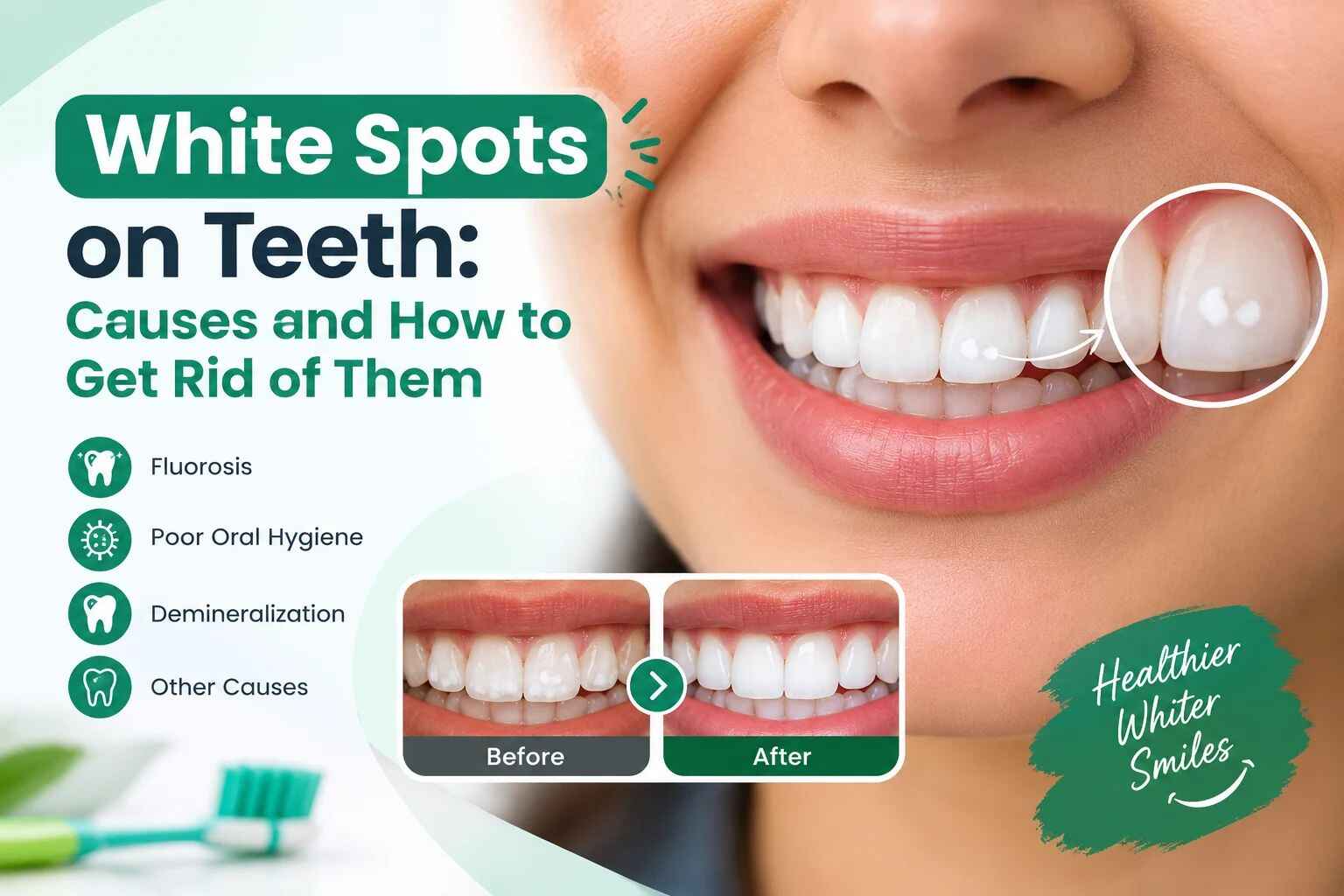
White spots on teeth usually come from one of three things: fluorosis (too much fluoride while the teeth were forming), enamel hypoplasia (a developmental defect in how the enamel formed), or early tooth decay — chalky patches where plaque has started dissolving the enamel, often around braces. Each one needs a different fix, which is why whitening your teeth and hoping for the best usually doesn't work.
Not Sure What's Causing Your White Spots?
New patient examination £25, £35 including X-rays when booked online. We'll identify the cause before recommending any treatment — not every white spot needs the same fix.
A white spot on a tooth can mean several different things, and they're not all treated the same way. Guessing doesn't help much here. This guide covers what's actually behind white spots, when to treat them, and what the treatment options involve.
What Causes White Spots on Teeth
| Cause | What it is | When it happens |
|---|---|---|
| Fluorosis | Enamel that formed with higher porosity due to fluoride exposure while the tooth was developing under the gum | Only during childhood tooth development — can't happen to adult teeth that have already erupted |
| Enamel hypoplasia / hypomineralisation | A developmental defect where the enamel didn't form or mineralise properly, sometimes linked to illness, fever or antibiotics during early childhood | Also only during tooth development; present from the time the tooth erupts |
| Early tooth decay (demineralisation) | Chalky white patches where acid from plaque bacteria has started dissolving the enamel — an early, reversible stage of decay | Any age, often where plaque sits longest: along the gumline, or around braces |
| Post-orthodontic decalcification | The same demineralisation process as above, specifically around or under brackets where cleaning is harder | During or shortly after fixed brace treatment |
| Dry mouth / reduced saliva | Saliva helps remineralise enamel; less of it means plaque acids do more damage | Any age — linked to some medications and medical conditions |
Fluorosis and hypoplasia both happen only while a tooth is still forming under the gum. So if a white spot has shown up on a tooth you've had, fully erupted, for years, it's far more likely to be early decay than either of those two.
Why This Matters More If You Grew Up in Birmingham
If you're reading this in Birmingham, fluorosis is a more plausible explanation than it would be for most of the UK. Birmingham's water has been fluoridated since 1964, one of the oldest and largest schemes in the country, and it's part of why the city's childhood tooth decay rates have historically compared well to nearby non-fluoridated cities like Manchester. The trade-off is that mild fluorosis runs somewhat more common here than in the roughly 90% of the UK without fluoridated water.
That doesn't mean fluoridated water is bad for your teeth. The evidence still comes down firmly in favour of it for cavity prevention. It just means that if you grew up drinking Birmingham tap water as a child, mild fluorosis is a reasonable explanation for faint white marks. Elsewhere in the UK, fluorosis is more often linked to young children swallowing toothpaste rather than the water supply itself. Either way, almost all UK fluorosis is mild and purely cosmetic.
Is It Serious, or Just Cosmetic?
Mostly cosmetic, with one exception worth taking seriously:
- Fluorosis: cosmetic only. It doesn't weaken the tooth or raise decay risk.
- Hypoplasia: usually cosmetic, but the enamel itself is thinner or defective, so these teeth can be more prone to decay and sensitivity. A dentist should take a look.
- Early decay / demineralisation: this is the one to act on. Technically, a white spot caused by demineralisation is the earliest stage of a cavity. Caught at this chalky-white stage, it's fully reversible with better cleaning and fluoride. Left alone, it progresses to an actual cavity that needs a filling.
What You Can Do at Home
If the cause is early demineralisation (not fluorosis or hypoplasia, which home care can't change), consistent habits over several weeks can reverse it:
- Brush twice daily with a fluoride toothpaste, and don't rinse with water straight after. Rinsing washes away the fluoride before it can work on the enamel
- Clean between teeth daily, especially around any fixed braces, where white spots form fastest
- Cut back on frequent sugary or acidic snacks and drinks. It's the frequency of acid attacks that matters more than the total amount
- Ask about the right fluoride strength for your age. Guidance differs for young children, older children and adults, and your dentist can confirm what applies to you
- Give it time. Remineralisation is gradual, so a few weeks of consistent habits is a realistic timeframe, not a few days
Professional Treatment Options
— Dr Mudasir Ur Rehman, GDC No. 196599. Read Dr Rehman's profile.
Once the cause is confirmed, the options range from doing nothing (plenty of people with mild fluorosis simply live with it) to an effective cosmetic fix:
Fluoride varnish and remineralising treatments
For early demineralisation, a dentist can apply a concentrated fluoride varnish, sometimes alongside a remineralising paste, to speed up the natural repair process beyond what home brushing alone achieves.
Resin infiltration (ICON)
This is the most effective option for white spots that home care and fluoride haven't resolved, particularly after braces. It works without any drilling:
- Etch. A gel is applied to open up the porous surface of the white spot for a few minutes, then rinsed off.
- Dry. The tooth is dried with a drying agent so the next stage can be properly absorbed.
- Infiltrate. A low-viscosity resin is applied directly onto the white spot. It's drawn into the microscopic pores of the demineralised enamel by capillary action over a few minutes.
- Cure. The resin is set hard with a curing light.
The resin fills in the porous areas that were scattering light and making the spot look white, so the tooth blends back in optically, often in a single visit. UK private clinics typically charge from around £250 per tooth for this treatment, based on published pricing. Ours is {{RESIN_INFILTRATION_PRICE}}.
Microabrasion
For superficial spots, a dentist can gently polish away a very thin layer of the outer enamel using a mildly abrasive compound. It's often combined with resin infiltration for a better result than either alone. Our price for this is {{MICROABRASION_PRICE}}.
Veneers or composite bonding
For deeper hypoplasia defects, or where other treatments haven't fully resolved the appearance, a thin veneer or composite bonding over the tooth surface can cover the area completely. This is a more involved and costlier option, usually reserved for cases the less invasive treatments can't fix.
Why Whitening Usually Isn't the Answer
It's a common first instinct, but teeth whitening doesn't fix white spots, and it can sometimes make them more obvious. Whitening bleaches the mineral structure of normal enamel, while a white spot is already a different, more porous structure. The surrounding tooth often ends up lighter while the spot itself barely changes, which increases the contrast instead of reducing it. If you're considering {{WHITENING_PAGE_URL}}, get white spots assessed and treated separately first.
Preventing White Spots
Fluorosis and hypoplasia are both decided during childhood tooth development, so prevention mainly means supervising young children's toothpaste use and not exceeding the fluoride strength appropriate for their age. For demineralisation, the type most people can actually influence, the usual decay-prevention habits apply: thorough twice-daily brushing, cleaning between teeth, limiting frequent sugar exposure, and regular dental check-ups so early white-spot decay gets caught before it becomes a cavity. Wearing fixed braces? Ask your orthodontist for specific tools to clean around the brackets, since that's where white spots form fastest.
White Spots on Teeth: FAQs
Can white spots on teeth be removed?
It depends on the cause. White spots from early demineralisation can often be reversed with better home care and fluoride. Fluorosis and hypoplasia don't resolve on their own, but can usually be treated cosmetically with resin infiltration, microabrasion, or in more severe cases, veneers or bonding.
Do white spots on teeth go away on their own?
Only if the cause is early demineralisation, which can reverse with consistent brushing and fluoride over several weeks. White spots from fluorosis or hypoplasia are permanent features of how the enamel formed and won't change without treatment.
Does teeth whitening remove white spots?
No. Whitening works on normal enamel and doesn't resolve the more porous structure behind a white spot. It can even make spots stand out more by lightening the surrounding tooth while the spot itself changes less.
What causes white spots after braces?
Plaque builds up more easily around brackets, and if it isn't cleaned off thoroughly, the acid it produces demineralises the enamel underneath — leaving a white spot once the brackets come off. This is the most common reason people seek white spot treatment as adults.
Can adults develop fluorosis?
No. Fluorosis only affects teeth while they're still forming under the gum, which finishes in childhood. A white spot that appears on an adult tooth that's been fully erupted for years is not fluorosis — it's more likely early decay.
Are white spots a sign of tooth decay?
Sometimes. If the spot is caused by demineralisation, yes — it's technically the earliest stage of a cavity, though a reversible one. If it's fluorosis or hypoplasia, it's a developmental feature rather than decay, though hypoplastic enamel can be more vulnerable to decay later.
How much does white spot treatment cost in the UK?
Resin infiltration (ICON) typically costs from around £250 per tooth privately in the UK, based on published clinic pricing. Microabrasion and fluoride varnish are usually less, and cost depends on how many teeth are affected. You'll be given a written price after an examination — our full fee list is on our dental prices page.
Get Your White Spots Assessed in Hall Green, Birmingham
New patient examination £25, £35 including X-rays when booked online. We'll confirm the cause and explain which treatment actually fits it, with a written price before anything starts.
Book online Call 0121 744 1484
1491 Stratford Road, Hall Green, Birmingham B28 9HT | Mon–Fri 8:30am–10pm, Sat 8:30am–8pm, Sun 9am–8pm
This article is for general information and does not replace advice from a dentist who has examined you. Our prices are correct as of September 2026 and are confirmed after an individual assessment.