Last updated: August 21, 2026
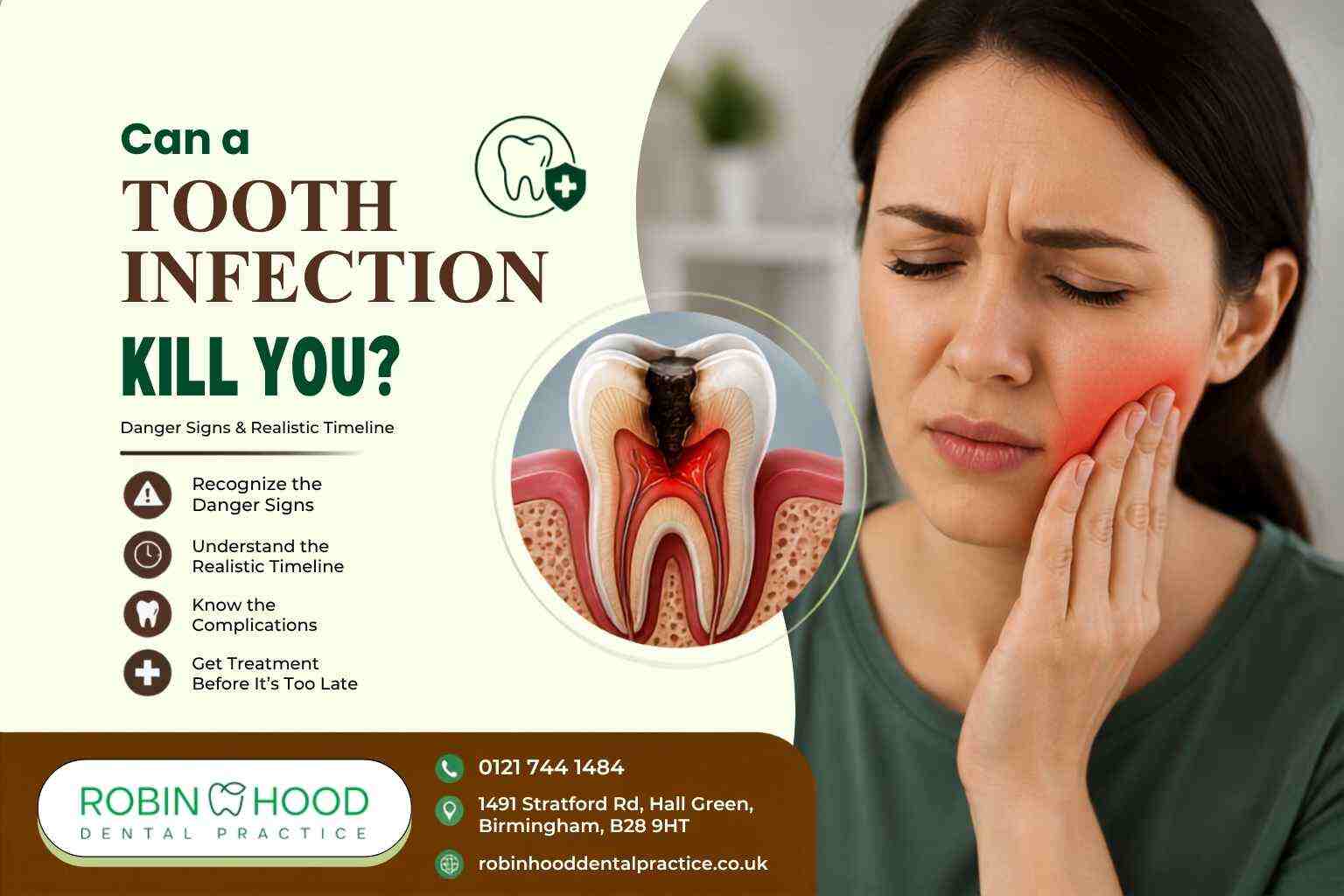
Quick answer: Yes, in rare cases an untreated tooth infection can become life-threatening — but this is uncommon, and it happens because the infection spreads beyond the tooth into deeper tissue, the airway, or the bloodstream (sepsis), not because of the tooth pain itself. There's no fixed number of days before this happens; it depends on the infection and the person. What matters is recognising the specific signs that mean it's moved beyond a routine dental problem, covered below.
How a Tooth Infection Spreads
A tooth infection starts contained — usually as decay reaching the nerve, or an abscess at the root tip. Left untreated, it doesn't stay contained indefinitely. It follows the path of least resistance through surrounding tissue, and where it goes determines how dangerous it becomes.
| Where it spreads | What happens | Why it matters |
|---|---|---|
| Into the jawbone | Localised bone infection (osteomyelitis) around the tooth | Painful and serious, but generally still a dental — not medical — emergency |
| Into the sinuses | Upper back teeth sit close to the sinus floor; infection can track upward | Causes sinus-type pain and pressure; rarely life-threatening on its own but needs treating at the tooth to resolve |
| Into the floor-of-mouth and neck spaces | Swelling spreads under the tongue and down into the neck (Ludwig's angina is the medical name for the most severe form) | This is the airway-risk pathway — the swelling can physically close off breathing. This is a 999 emergency. |
| Into the bloodstream | Bacteria enter circulation and can trigger sepsis — the body's own extreme response to infection | This is where "can a tooth infection kill you" becomes a real question rather than a scare headline. This is a 999 emergency. |
The overwhelming majority of tooth infections never reach the last two rows of that table. Most people who leave a dental infection untreated end up with worsening local pain and swelling that gets them into a dental chair before it goes any further — not in A&E. But the small minority where it does progress is exactly why the red flags further down this page matter more than the pain scale.
How Long Does It Actually Take?
This is the honest answer, not the reassuring one: there's no reliable fixed timeline. Some infections stay contained and slowly worsening for weeks. Others — particularly in someone with a weaker immune system, or where swelling starts tracking into the neck rather than staying local — can deteriorate seriously within 24–48 hours. You cannot predict which pattern you're dealing with just from how it feels on day one, and pain level specifically is a poor guide: some of the most dangerous presentations are less painful than the infection was a few days earlier, because pressure has found a way to spread rather than because anything has improved.
What this means practically: don't use "it's not that bad yet" as your gauge for whether to seek help. Use the specific signs below instead.
Sepsis: What It Looks Like
Sepsis is the body's own immune response to an infection overreacting badly enough to injure its own organs and tissue, and it's the mechanism behind almost every genuinely fatal case connected to a dental infection. It's rare, but it's the reason this topic deserves a straight answer rather than a dismissive one.
According to the NHS, the signs of sepsis in adults include confusion or slurred speech, skin that looks pale, blue, grey, or blotchy, a very high or very low temperature, and passing little or no urine over the course of a day. Sepsis is always a medical emergency and needs hospital treatment — it is not something a dentist can manage in the chair, and it is not something to wait out.
If you or someone you're with has an infection anywhere near a tooth or jaw and starts showing any of those signs, that's a 999 call or A&E visit, not a same-day dental booking.
Red Flags — When to Call 999
Call 999 or go straight to A&E if a tooth or gum infection comes with any of the following:
- Difficulty breathing or swallowing — even mild difficulty, not just severe
- Swelling that's spreading toward the eye, or down into the neck — not staying localised to the gum
- A mouth that won't fully open (trismus), especially combined with swelling
- Fever with facial or neck swelling together — either alone is more often manageable; the combination is the concerning pattern
- Any sign of sepsis as described above — confusion, blotchy or discoloured skin, very high or low temperature, not urinating
- Feeling seriously unwell in a way that's out of proportion to a toothache — trust this instinct
A GP surgery cannot treat a dental infection at this stage either — this needs hospital-level assessment and, usually, IV antibiotics, sometimes surgical drainage of deeper tissue spaces. If you're not registered with a dentist and none of the above applies but you're still in significant pain, NHS 111 can direct you to emergency dental provision.
For the full picture of what an abscess looks like at each stage before it reaches this point, see our guide on tooth abscess stages, symptoms and treatment.
Who's at Higher Risk
Anyone can develop a serious dental infection, but a few factors make rapid spread or sepsis more likely: diabetes (particularly poorly controlled), a weakened immune system from illness or medication, being elderly or very young, pregnancy, and having had recent surgery. If any of these apply to you, treat borderline symptoms more urgently rather than waiting to see how they develop — the margin for "wait and see" is smaller.
While You're Waiting for Help
- If any red flag above applies, call 999 now — don't finish reading this page first.
- Stay upright rather than lying flat if there's facial or neck swelling — it can ease pressure on the airway.
- Don't attempt to drain anything yourself — pushing on a swollen area can push infection further into deeper tissue.
- Cold compress on the outside of the face can take the edge off swelling and discomfort while you wait.
- Paracetamol or ibuprofen at standard doses for pain, unless you have a medical reason not to take either. Don't give aspirin to anyone under 16.
- Don't wait for antibiotics to "kick in" before seeking further help if things are getting worse, not better — antibiotics alone don't treat an infection that's already spreading through tissue spaces.
Treatment
Treatment depends entirely on how far things have progressed. A localised infection is treated the same way any dental infection is — drainage, root canal treatment, or extraction of the source tooth, exactly as covered in our abscess treatment guide. Where infection has spread into deeper tissue spaces or triggered sepsis, that part of the treatment happens in hospital — IV antibiotics, monitoring, and sometimes surgical drainage of the affected spaces. The tooth itself still has to be dealt with afterward, once the person is medically stable; hospital treatment resolves the emergency, not the underlying dental cause.
Once you're through the acute phase (or if you've caught this early and it hasn't progressed that far), same-day dental treatment is available at Robinhood Dental — see our emergency dentist page for how that works. A same-day consultation is £35, and an antibiotic prescription where clinically appropriate is £20; these are bridging measures rather than a cure on their own, for exactly the reasons explained above.
FAQs
How long can you leave a tooth infection before it becomes dangerous?
There's no reliable fixed timeline — it can be days in some cases and weeks in others, and you can't tell which from symptoms alone. Treat it as soon as you notice it rather than trying to judge how much time you have.
What is Ludwig's angina?
It's the medical term for a severe infection spreading into the floor of the mouth and neck, usually starting from a lower back tooth. It's dangerous specifically because the swelling can compress the airway. It's a genuine 999 emergency, not something to manage with antibiotics and time.
Can a tooth infection cause sepsis?
Yes, though it's uncommon. It happens when bacteria from the infection enter the bloodstream and trigger the body's own extreme inflammatory response. It's the mechanism behind the rare fatal cases connected to dental infections, which is why the sepsis signs above are worth knowing.
Can a tooth infection kill you in your sleep?
Death from an untreated tooth infection is rare and, when it happens, is not sudden or silent — it follows a period of worsening symptoms (spreading swelling, fever, feeling increasingly unwell) rather than occurring with no warning. This is exactly why acting on the red flags early matters, rather than waiting to see if things improve overnight.
Is a tooth infection an emergency if there's no swelling?
Not usually — pain without swelling or fever is far more often a straightforward, if urgent, dental problem than a medical emergency. The combination of fever, spreading swelling, breathing or swallowing difficulty, or feeling seriously unwell is what changes that.
Will antibiotics stop a tooth infection from spreading?
They can slow it down and buy time, but they don't cure the underlying cause and infection can still progress on antibiotics if the source — usually a dead or dying nerve — isn't treated. If things are getting worse rather than better while on antibiotics, that's a reason to seek further help, not to wait out the course.
Key Takeaways
- A tooth infection killing someone is rare, and it happens through spread to deeper tissue or the bloodstream (sepsis) — not from the toothache itself.
- There's no fixed safe number of days — some infections progress in 24–48 hours, others take weeks. Don't use pain level or time elapsed as your only guide.
- Difficulty breathing or swallowing, spreading facial/neck swelling, a mouth that won't open, fever with swelling, or any sign of sepsis (confusion, blotchy skin, very high or low temperature, not urinating) mean 999 or A&E — not a dental appointment.
- Antibiotics buy time; they don't cure the underlying cause. The tooth still needs treating once the emergency is resolved.
Worried About a Spreading Infection?
If none of the red-flag emergency signs above apply to you, Robinhood Dental Practice offers same-day appointments for dental infections and abscesses.
Robinhood Dental Practice
1491 Stratford Road, Hall Green, Birmingham B28 9HT
Tel: 0121 744 1484
Open 7 days a week
This article is for general information and does not replace individual clinical assessment. If you are experiencing any of the emergency signs described above, call 999 or go to A&E immediately rather than relying on this guide.