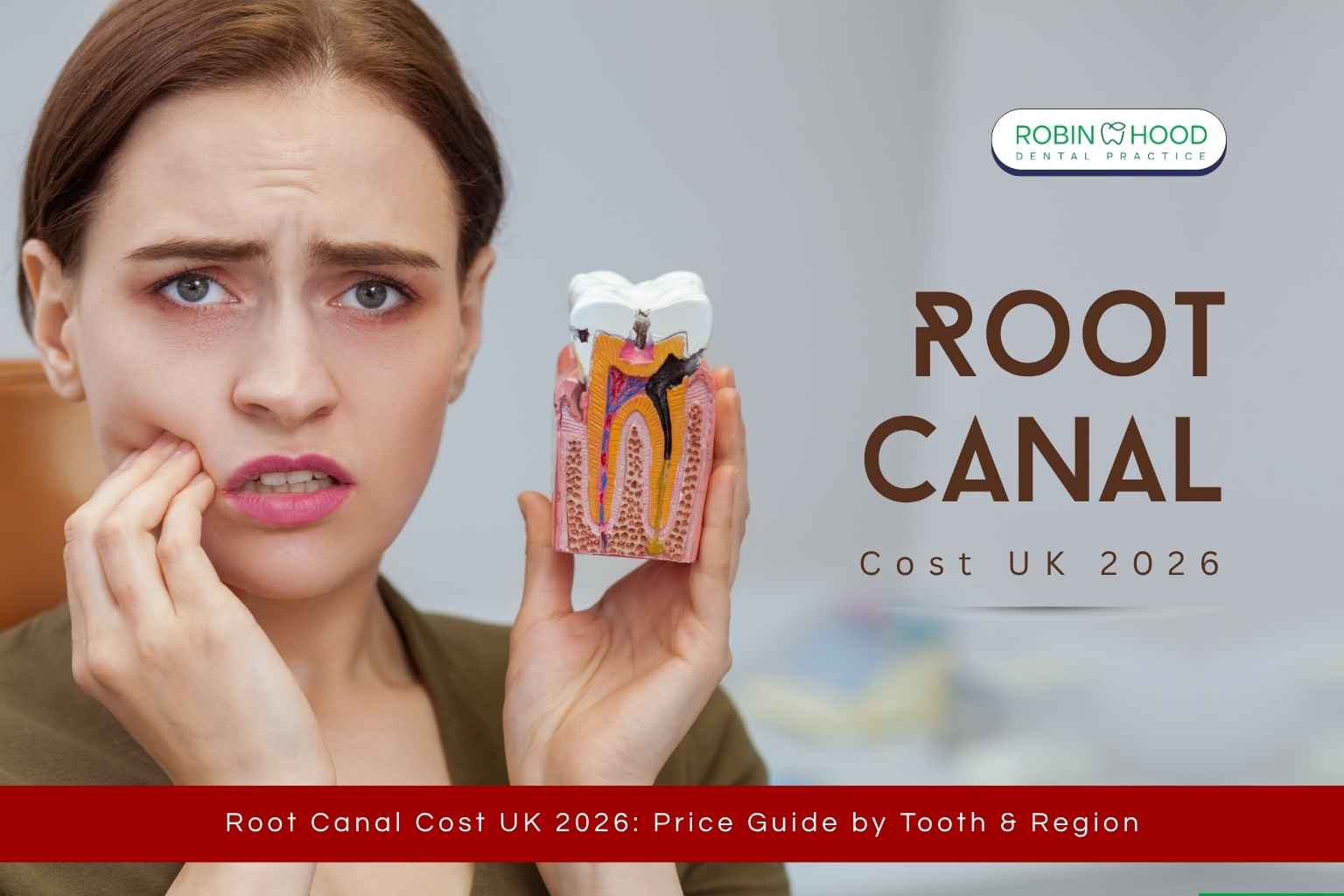
Medically reviewed by Dr Mudassir (GDC: 196599), Robinhood Dental Practice | Last updated: 28 August 2026
Root canal treatment is one of the most common — and most feared — dental cost questions in the UK. Prices vary enormously depending on which tooth needs treating, whether you go private or NHS, which part of the country you're in, and whether a general dentist or a specialist endodontist does the work.
This guide pulls together current 2026 UK-wide pricing so you know roughly what to expect before you sit in the chair — plus the regional differences most cost guides skip entirely.
Quick Answer
In the UK in 2026, NHS root canal treatment costs a fixed £76.60 (Band 2, April 2026 rate) regardless of which tooth is treated. Privately, a root canal costs £350–£480 for a front tooth, £450–£650 for a premolar, and £600–£950 for a molar — rising to £800–£1,500+ with a specialist endodontist on complex cases. Including a crown, total private root canal treatment in the UK typically costs between £750 and £1,900.
NHS treatment is far cheaper than private treatment, but NHS dental capacity is limited across the UK in 2026 and many practices are not accepting new adult patients, which is why most people needing prompt treatment choose a private dentist despite the higher cost.

NHS Root Canal Cost (2026)
NHS root canal treatment in the UK falls under Band 2, which costs £76.60 as of the April 2026 NHS dental charge rates. This Band 2 charge is the same fixed fee whether the tooth being treated is a straightforward front tooth or a complex molar with four canals, and it also covers any fillings and extractions carried out in the same course of treatment.
If a crown is needed straight after the root canal, the whole course of treatment moves up to Band 3 — £332.10, covering both procedures together.
The catch is access, not price. NHS dental capacity is stretched across most of the UK in 2026, and many practices aren't accepting new adult patients. If you're in pain now, a private appointment is often the only realistic route to same-week treatment — even though it costs more.
Private Root Canal Cost by Tooth Type
Tooth anatomy is the single biggest driver of private pricing. More canals means more time in the chair, more instrumentation, and a higher fee.
| Tooth Type | Canals | UK Private Price Range (2026) |
|---|---|---|
| Incisor / Canine (front tooth) | 1 | £350 – £480 |
| Premolar | 1–2 | £450 – £650 |
| Molar (back tooth) | 3–4 | £600 – £950 |
| Specialist Endodontist (complex case/retreatment) | Varies | £800 – £1,500+ |
These are per-tooth fees for the root canal procedure itself. A crown, X-rays, and consultation are usually priced separately — see below.
How Much Does Location Change the Price?
Most cost guides quote a single UK-wide range and stop there. In practice, where you live changes the bill significantly — sometimes by several hundred pounds for the same tooth.
| Region | Typical Private Root Canal Cost | Relative to UK Average |
|---|---|---|
| Edinburgh & Scotland (major cities) | £600 – £1,200+ | Highest in the UK |
| London & South East | £550 – £1,100 | Above average |
| Midlands (Birmingham & surrounding areas) | £350 – £950 | Below average |
| North West & North East England | £400 – £950 | Below average |
| Wales & Northern Ireland | £350 – £900 | Below average |
The pattern holds across most dental procedures, not just root canals: city-centre rent and local demand push prices up, while regions with more practices competing for patients tend to hold prices down. If you're specifically looking for pricing in Birmingham, our Birmingham root canal cost guide breaks down local prices, real treatment scenarios, and payment plan options in more detail.
General Dentist vs Specialist Endodontist
An endodontist is a dentist who has completed several years of additional specialist training focused entirely on root canal treatment, and typically works under an operating microscope with advanced imaging equipment.
According to Dr Mudassir (GDC: 196599) at Robinhood Dental Practice, published clinical outcome data generally puts success rates for specialist endodontists at around 95% on complex molar cases, compared with roughly 85% for a general dentist treating the same type of case.
- Success rate: specialist endodontists achieve around 95% success on complex molar root canals, versus roughly 85% for a general dentist on the same case.
- Cost: specialist endodontists typically charge £800–£1,500+ for complex or retreatment cases, while a general dentist typically charges £400–£950 for a straightforward case.
- When it matters most: on simple, single-canal front teeth, a general dentist and a specialist achieve similar outcomes. On curved, calcified, or previously-treated canals, the specialist's higher success rate becomes more significant.
Most general dentists in the UK will refer a patient to a specialist endodontist if the case genuinely requires one — patients typically do not need to decide this for themselves.
Additional Costs Beyond the Root Canal Fee
| Cost Element | Typical Price Range (2026) |
|---|---|
| Initial consultation / examination | £30 – £100 |
| Standard X-ray | £20 – £80 |
| CBCT (3D scan) — complex/curved roots | £100 – £250 |
| Crown (usually needed on back teeth) | £350 – £950 |
The crown is the cost most patients don't budget for. A molar root canal quoted at £700 can realistically become a £1,300–£1,650 total once the crown is included. Always ask your dentist for the full treatment cost — root canal plus crown — before you commit, not just the headline procedure fee.
Real Cost Scenarios
Three realistic examples of total private treatment cost, based on current UK pricing:
Scenario 1 — Front tooth, straightforward case
Consultation: £45 | Root canal: £420 | Composite filling: £180
Total: £645
Scenario 2 — Premolar, standard case
Consultation: £45 | Root canal: £550 | Crown: £550
Total: £1,145
Scenario 3 — Molar, complex case with specialist referral
Consultation: £70 | CBCT scan: £180 | Root canal (specialist): £950 | Crown: £700
Total: £1,900
Managing the Cost
- Payment plans: most private practices now offer monthly instalment options, some interest-free for qualifying patients.
- Dental insurance: check your policy — many plans cover root canal treatment partially or fully.
- NHS Low Income Scheme: if you're on a low income, you may qualify for free or reduced-cost NHS treatment via the HC1 form at nhsbsa.nhs.uk/help-nhs-costs, even if you don't receive benefits.
- Shop around, but not blindly: prices vary significantly by region and practice — get more than one quote, but weigh it against the dentist's experience and reviews, not price alone.
Root Canal vs Extraction: Which Costs Less Long-Term?
Extraction is cheaper upfront — NHS Band 2 (£76.60, same as root canal) or £100–£250 privately. But it leaves a gap that can shift adjacent teeth and shrink the jawbone within months, often making a future implant (£2,000–£3,500) or bridge (£800–£1,800) necessary.
In most cases where the tooth is genuinely saveable, root canal treatment works out cheaper than extraction plus replacement over a 10-year horizon. Read our full comparison of root canal vs extraction to see which makes sense for your situation.
Frequently Asked Questions
How much does a root canal cost in the UK in 2026?
NHS treatment is a fixed £76.60 (Band 2). Privately, expect £350–£950 depending on the tooth, rising to £1,500+ for specialist or complex cases.
Why do root canal prices vary so much by region?
Rent, local demand, and the concentration of specialist endodontists all affect pricing. Scotland and London/South East tend to be most expensive; the Midlands, North of England, Wales, and Northern Ireland tend to be more affordable.
Does the NHS cover the crown after a root canal?
If the crown is placed in the same course of treatment, the whole thing is billed as Band 3 (£332.10). A crown fitted later as a separate course of treatment is priced separately.
Is a specialist endodontist worth the extra cost?
For straightforward single-canal front teeth, a general dentist typically achieves similar results. For complex molars, curved canals, or retreatment cases, a specialist's higher success rate (around 95% vs 85%) can justify the premium.
What happens if I don't treat an infected tooth?
The infection doesn't resolve on its own — it spreads to surrounding bone and tissue, and the tooth is eventually lost. Replacing it afterwards costs significantly more than treating it now.
Do I always need a crown after root canal treatment?
Not always. Front teeth with enough remaining structure sometimes only need a filling. Back teeth (premolars and molars) almost always need a crown, since they bear the force of chewing.
How many appointments does root canal treatment take?
Most cases are completed in one to two appointments of roughly 60–90 minutes each. Molars with more canals, or cases with significant infection, sometimes need a second visit.
Key Takeaways: Root Canal Cost UK 2026
NHS root canal treatment in the UK costs a fixed £76.60 (Band 2) across the whole country, regardless of location or tooth type. Private root canal treatment in the UK typically costs £350–£950 depending on the tooth, with regional variation adding several hundred pounds either way: Scotland and London/South East sit above the national average, while the Midlands and North of England tend to be more affordable. When a crown is included, realistic total private root canal treatment in the UK costs £750–£1,900.
According to Dr Mudassir (GDC: 196599) at Robinhood Dental Practice, the most important factor is not the price itself but the cost of delay: an infection left untreated does not resolve on its own, becomes more expensive to treat as it progresses, and can ultimately result in losing the tooth.
Patients in the UK considering root canal treatment can book an examination at Robinhood Dental Practice for a clear written cost breakdown specific to their tooth.