Teeth Whitening Cost UK: The Real Price, Not Just a Range
On July 30, 2026
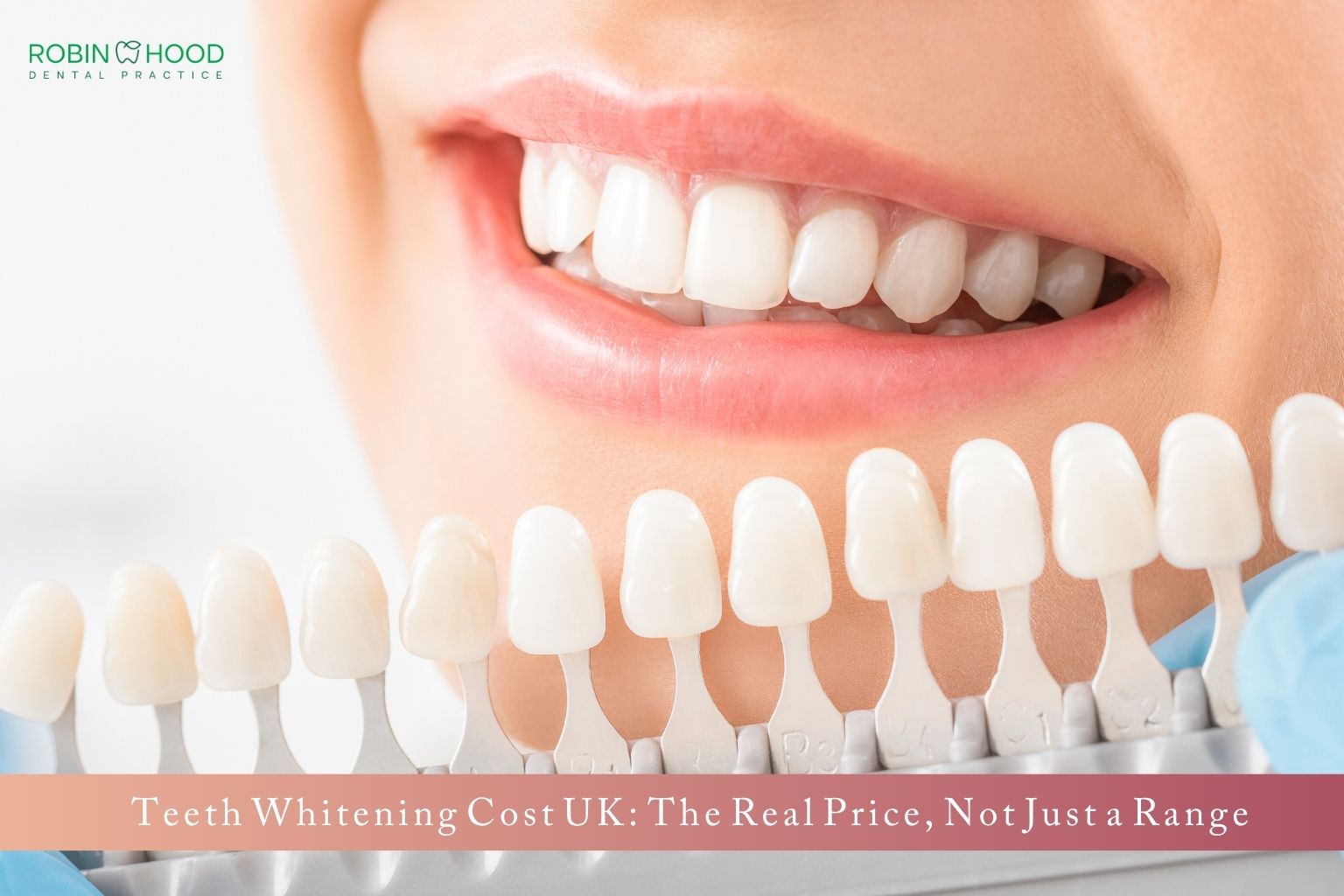
Quick answer: Professional teeth whitening in the UK typically costs between £150 and £800 depending on the method. In-chair whitening (done in one visit at the practice) generally runs £300–£700. Take-home kits with custom trays cost less, usually £175–£475, but take two to three weeks to reach full results. At Robinhood Dental Practice in Hall Green, Birmingham, professional tooth whitening costs £350 — below the UK's reported national median of £380 across private practices.
If you've typed "teeth whitening cost UK" into Google, you've probably noticed the numbers don't agree with each other. One site says £200, another says £1,000, and neither explains why. The honest answer is that both figures can be correct — they're just describing different types of professional whitening treatment. This guide breaks down exactly what you're paying for at each price point, what the real risks and side effects are, and which option actually suits your teeth, your timeline and your budget.
Key Takeaways at a Glance
✓
UK price range: professional whitening costs £150–£800, with a national median around £380.
✓
In-chair whitening: £300–£700, same-day results, typically 6–8 shades lighter.
✓
Take-home kits: £175–£475, results in 2–3 weeks, typically 4–8 shades lighter.
✓
Robinhood Dental Practice: £350 for professional whitening — below the UK national median.
✓
Both methods reach a broadly similar end result — the real trade-off is speed and cost, not quality.
✓
Mild-to-moderate sensitivity is common and temporary, usually settling within days to two weeks.
✓
Decay, gum disease, or damaged fillings should be treated before whitening.
✓
Salon or mobile whitening above 0.1% peroxide is illegal in the UK unless performed by a GDC-registered professional.
✓
The NHS doesn't cover whitening because it's considered a cosmetic treatment.
✓
Results typically last 12–18 months; top-up gel is cheaper than repeating the full treatment.
| Provider Type | Typical Cost | Includes |
|---|---|---|
| Robinhood Dental Practice | £350 | Professional whitening with a GDC-registered dentist |
| UK National Median | £380 | Varies by practice |
| Typical London Clinics | £400–£800 | Usually higher overhead costs |
What Robinhood Dental Birmingham Charges for Teeth Whitening
We keep our pricing straightforward rather than burying it behind a "contact us for a quote" form. Here's what whitening and the appointments around it cost at our Hall Green practice:
| Treatment | Price |
|---|---|
| New Patient Examination | £25 |
| Tooth Whitening | £350 |
| Hygiene Clean (HYGIENIST) | £64.50 |
That £350 figure covers a full professional whitening course with a GDC-registered dentist — not a same-price-different-service comparison to the beauty-salon offers you might see advertised locally. Those aren't legal in the UK for a reason we'll get to below. You can see our full fee list on our dental prices page, or book your New Patient Examination online.
Teeth Whitening vs Teeth Bleaching: Is There a Difference?
No — "whitening" and "bleaching" are used interchangeably by most patients, and by many dentists too. Both refer to exactly the same professional treatment: a peroxide-based gel that lightens the natural colour of your teeth. "Bleaching" tends to show up more in older or clinical literature, while "whitening" has become the more common consumer-facing term — but whichever word you search for or ask us about, the tooth bleaching cost and the teeth whitening cost at Robinhood Dental Practice refer to the exact same procedure and the exact same £350 price.
UK-Wide Teeth Whitening Prices in 2026: The Real Range
Pulling together current 2026 pricing data from UK dental practices, professional whitening costs a median of roughly £380, with most patients paying somewhere between £150 and £700 depending on treatment type. London clinics tend to sit at the higher end of that range — often £400 to £800 for in-chair treatment — while practices outside the capital, including most of the West Midlands and Birmingham specifically, are typically £50 to £150 cheaper for the same treatment. If you're comparing a London quote to a Birmingham one, that gap is expected, not a red flag on either side.
| Whitening Type | Typical UK Price Range | Time to Results |
|---|---|---|
| Take-home kit (dentist-supplied trays) | £175 – £475 | 2–3 weeks |
| In-chair whitening (e.g. Zoom, Enlighten) | £300 – £700 | Same day (60–90 min) |
| Combination (in-chair + home top-up trays) | £400 – £800 | Same day, maintained over weeks |
| Over-the-counter strips/pens (not professional) | £10 – £50 | Weeks, limited/inconsistent effect |
The gap between the cheapest and most expensive professional options isn't random. It comes down to three things: how the gel is activated, how long the appointment takes, and how much chairside dentist time is involved.
What Causes Tooth Stains? Extrinsic vs Intrinsic Discolouration
Not all tooth stains respond to whitening the same way, which is part of why results vary so much between patients. Dentists group discolouration into two categories. Extrinsic stains sit on the outer enamel surface and come from everyday habits — coffee, tea, red wine, curry, and smoking are the usual causes. These respond well to whitening gel, since the peroxide simply breaks down the stain molecules sitting on and just beneath the enamel surface.
Intrinsic stains sit deeper, within the dentine layer beneath the enamel, and are usually caused by things like ageing, certain antibiotics (particularly tetracycline) taken during childhood, excess fluoride exposure, or trauma to a tooth. Intrinsic staining generally needs a longer whitening course to shift, and severe cases — especially tetracycline banding — may respond better to composite bonding or veneers as a cosmetic dental treatment than to whitening alone. A dentist can usually tell which type of staining you have during a routine cosmetic dentistry consultation, which is part of why an assessment matters more than picking a whitening method off a price list.
Teeth Whitening Systems Explained: Zoom, Enlighten, Laser and Boutique
You'll see several brand names come up when researching whitening, and they're worth understanding even in general terms, because they're not interchangeable. Philips Zoom and Enlighten are both in-chair systems using light or heat-activated gel for same-day results — Enlighten in particular is often marketed around achieving a specific target shade (B1) rather than "as white as possible." Laser whitening is a similar in-chair category, using a laser rather than an LED light to activate the gel, with broadly comparable results and pricing. Boutique Whitening is a well-known take-home brand, providing custom trays and graduated-strength gel for use over two to three weeks.
The underlying chemistry is the same across all of them — hydrogen or carbamide peroxide, capped by UK law at 6% for professional use — so the brand name mostly tells you about the delivery method and protocol, not a fundamentally different level of whitening power.
In-Chair Whitening: What You're Actually Paying For
In-chair whitening — sometimes called "power whitening" — happens entirely at the practice in a single appointment, usually 60 to 90 minutes. The dentist applies a high-concentration hydrogen peroxide gel directly to your teeth, often activated with an LED or laser light to speed up the reaction. Clinical data suggests properly administered in-chair whitening typically lightens teeth by around 6–8 shades on the standard Vita shade guide in one session, though your starting shade affects how much room there is to improve.
Because the process needs a dentist present throughout, and because the gel strength is higher, this route sits at the top of the price range — typically £300 to £700 in the UK. It's the option most people choose when they have a deadline: a wedding, an interview, a big event where "two weeks from now" isn't good enough.
Take-Home Kits: The Slower, Cheaper Route
With dentist-prescribed take-home whitening, your dentist takes an impression of your teeth at the practice and has custom whitening trays made to match your mouth exactly — not the generic, one-size-fits-most trays you'd get from a pharmacy kit. You're given professional-strength whitening gel to use at home in these home whitening trays, typically worn for 30–60 minutes a day (or overnight, depending on the gel used) for around two to three weeks. Most patients completing a full course see results in the range of 4–8 shades lighter on the Vita guide, and the NHS itself confirms that tray-based whitening can lighten teeth by several shades when instructions are followed correctly.
Results build up gradually rather than appearing instantly, but for most patients the final shade achieved is comparable to in-chair whitening — you're simply trading speed for a lower price. Because there's less chairside time involved, take-home kits usually cost £175 to £475 in the UK, meaningfully less than the in-chair route. Whitening only works on natural enamel, so if you're also considering porcelain veneers, plan the whitening first — veneers get matched to your new shade, not the other way round.
In-Chair vs Take-Home: Side-by-Side
| Comparison | In-Chair Whitening | Take-Home Kit |
|---|---|---|
| Typical UK Cost | £300–£700 | £175–£475 |
| Time to Full Results | Same appointment | 2–3 weeks |
| Dentist Chair Time | 60–90 minutes, one visit | ~30 minutes for impressions only |
| Typical Shade Improvement | 6–8 shades (Vita guide) | 4–8 shades (Vita guide) |
| Sensitivity | More noticeable short-term, settles within days | Milder, more gradual |
| Best For | Upcoming events, impatience, dramatic before/after | Budget-conscious patients, no fixed deadline |
| Result Longevity | 12–18 months typically | 12–18 months typically |
Worth noting: the final result you end up with is largely similar between the two methods. The trade-off is really speed and dentist involvement versus cost, not "better" versus "worse" whitening.
Does Teeth Whitening Hurt? Sensitivity Explained
Some degree of sensitivity is common and expected, not a sign something has gone wrong. Clinical research on dentist-supervised take-home whitening (using a 16% carbamide peroxide gel) found that roughly half of patients experience mild sensitivity, around 10% experience moderate sensitivity, and about 4% experience severe sensitivity — usually settling within one to two weeks after finishing the course. In-office whitening, which uses a stronger gel, tends to produce sensitivity that's more noticeable but shorter-lived, often peaking immediately after treatment and easing significantly within 24 hours.
Patients with existing gum recession are more likely to notice sensitivity, since the exposed root surface lacks the protective enamel layer. A dentist can apply a desensitising agent before in-office whitening to reduce this, and sensitive toothpaste use in the days before and after treatment helps with both methods. If sensitivity is severe or doesn't ease within the expected window, that's worth flagging to your dentist rather than pushing through it.
Who Shouldn't Get Teeth Whitening?
Whitening isn't right for everyone, and a proper assessment before treatment exists to catch this. Your dentist will typically advise against whitening, or delay it until an underlying issue is treated first, if you have:
- Active tooth decay or gum disease — whitening gel can irritate exposed or compromised areas, and decay should be treated first regardless
- Existing tooth sensitivity — whitening will usually make this worse, at least temporarily
- Cracked, chipped, or failing fillings — gel can seep into gaps and cause discomfort; these should be repaired before whitening
- Pregnancy or breastfeeding — not because whitening is known to be harmful, but because there isn't enough safety data, so most dentists recommend waiting
- Under-18 — whitening above 0.1% hydrogen peroxide is restricted to over-18s in the UK by law, except for specific medical reasons
- Crowns, veneers or fillings on the teeth you want whitened — these won't change colour, which can leave you with an uneven result rather than a health risk
None of these are usually permanent obstacles — most just mean treating the underlying issue first, then whitening once your mouth is in a stable, healthy state.
Is Salon Teeth Whitening Legal in the UK?
One reason you'll sometimes see suspiciously cheap whitening advertised — beauty salons, mobile "technicians," pop-up stalls — comes down to concentration limits. UK regulation, enforced under the General Dental Council, caps hydrogen peroxide at 6% for whitening carried out or prescribed by a registered dental professional, and products above 0.1% cannot legally be used on anyone under 18 except for specific medical reasons. Whitening performed by anyone other than a GDC-registered dentist, hygienist or therapist working under prescription isn't just unregulated — under the Dentists Act, it's the practice of dentistry, and doing it without registration is a criminal offence.
The price angle is simple: if a quote seems far below the £150–£700 range covered here, that's usually the reason why, not a bargain. You can check any dentist's registration status directly through the GDC.
Why Isn't Teeth Whitening Covered by the NHS?
Teeth whitening is classified as a cosmetic procedure in the UK, so it falls outside NHS treatment bands entirely — the NHS confirms teeth whitening is cosmetic and therefore generally only available privately. The only exception is a specific clinical case, such as whitening a single tooth that's discoloured following an injury, and even then it's assessed individually. For the vast majority of patients, whitening is a private treatment regardless of which dentist you go to.
Which Option Should You Choose?
If you've got a specific date to work towards — a wedding, a photoshoot, a big presentation — in-chair whitening is the more reliable choice simply because the timeline is fixed: one appointment, done. If you're whitening for yourself rather than a deadline, take-home trays deliver a very similar end result for less money, and a lot of patients actually prefer being able to control the process at home on their own schedule.
Either way, a proper assessment matters more than the marketing around either option. If you're planning restorative work such as dental implants or crowns alongside whitening — or building whitening into a wider smile makeover with veneers or bonding — the sequencing matters — whiten first, then match any new cosmetic dental treatment to your updated shade.
Whitening Maintenance: Results and What Top-Up Gel Costs
Whichever method you choose, results generally last 12 to 18 months before noticeable fading, depending on diet and habits — coffee, tea, red wine and smoking are the usual culprits for teeth going back to their old shade faster. Ongoing whitening maintenance is usually just a matter of topping up rather than starting again: most practices offer whitening top-up gel for existing take-home tray patients, which is considerably cheaper than repeating the full treatment, since you already own the custom trays.
Frequently Asked Questions
How much does teeth whitening cost in the UK in 2026?
Professional teeth whitening in the UK costs between £150 and £800 depending on the method, with a national median around £380. In-chair treatment sits at £300–£700, while take-home kits are typically £175–£475.
Is in-chair whitening better than take-home kits?
Not necessarily “better” — the final shade achieved is usually similar with both methods. In-chair whitening is faster (same-day results), while take-home kits are cheaper and give you more control over the process, just spread over two to three weeks.
Does teeth whitening hurt?
Some sensitivity is common. Studies on take-home whitening show around half of patients get mild sensitivity, roughly 10% moderate, and about 4% severe, usually settling within one to two weeks. In-chair whitening tends to cause more noticeable but shorter-lived sensitivity, often easing within 24 hours.
Who shouldn't get teeth whitening?
Whitening is usually delayed or avoided for people with active decay, gum disease, existing sensitivity, cracked or failing fillings, and for anyone under 18 or pregnant. Most of these are temporary obstacles rather than permanent ones.
Can I whiten my teeth if I have veneers or crowns?
Whitening gel only works on natural tooth enamel — it won't change the colour of crowns, veneers, or composite bonding. If you're planning restorative work, it's best to whiten first so the new work can be colour-matched to your updated shade.
How many shades whiter can I expect?
Most patients see a 4–8 shade improvement on the Vita shade guide, with in-chair treatment typically at the higher end (6–8 shades) and take-home kits ranging 4–8 shades depending on how consistently the trays are worn.
Why is teeth whitening not available on the NHS?
Teeth whitening is classified as a cosmetic treatment rather than a clinical necessity, so it sits outside NHS treatment bands. The only exception is whitening a single tooth for a specific clinical reason, such as discolouration following trauma.
Is cheap teeth whitening from a beauty salon safe?
No. In the UK, only a registered dental professional can legally perform or prescribe teeth whitening above 0.1% hydrogen peroxide. Salon or “mobile technician” whitening operating outside this is unregulated and, in most cases, illegal — cheap pricing is usually a sign of this rather than a genuine discount.
How long does professional teeth whitening last?
Most patients see results lasting 12 to 18 months before noticeable fading, depending on diet, smoking, and how much tea, coffee or red wine they consume. Top-up gel can extend results without repeating the full treatment.
What's the actual cost difference between in-chair and take-home teeth whitening?
It comes down to how much dentist time is involved. In-chair whitening happens in one 60–90 minute visit, so you're paying for the dentist's chairside time and equipment — typically £300 to £700. Take-home kits only need about 30 minutes for impressions, then you whiten yourself over 2–3 weeks, which is why they're cheaper — usually £175 to £475. The end result is genuinely similar either way; you're really choosing between paying more for speed or saving money and being patient.
How much does teeth whitening cost in Birmingham?
At Robinhood Dental Practice in Hall Green, professional whitening costs £350 — below the UK's national median of around £380, and noticeably cheaper than London, where the same treatment often runs £400 to £800. Birmingham and the wider West Midlands typically sit £50–£150 below London prices for identical treatment, mostly down to lower overheads rather than lower quality.
How much does teeth whitening really cost in the UK?
Honestly, it depends which type of whitening you're being quoted for, and most sites don't make that clear. A number around £150 is usually a take-home kit; £700-plus is probably in-chair or a premium system. Across the UK, professional whitening from a GDC-registered dentist typically falls between £150 and £800, with most people paying somewhere in the £300–£450 range. Anything well below £150 usually isn't being done by a registered dentist — worth knowing before booking on price alone.
What's the full breakdown of teeth whitening prices in the UK?
Over-the-counter strips run £10–£50 but aren't professional treatment. Dentist-supplied take-home kits are £175–£475 and take 2–3 weeks. In-chair whitening (like Zoom or Enlighten) is £300–£700, done in one visit. Combine an in-chair session with take-home top-up trays and expect £400–£800. The national median across all professional treatment sits around £380.
Book Your Teeth Whitening Consultation in Birmingham
Robinhood Dental Practice offers professional teeth whitening for £350, following a New Patient Examination at £25. We're based at 1491 Stratford Road, Hall Green, Birmingham B28 9HT, open seven days a week, and led by Dr Mudasir, GDC No. 196599 (20+ years' experience). Call 0121 744 1484 or book online to find out whether in-chair or take-home whitening is the better fit for your teeth.