All-on-4 Dental Implants: The Complete Guide (2026)
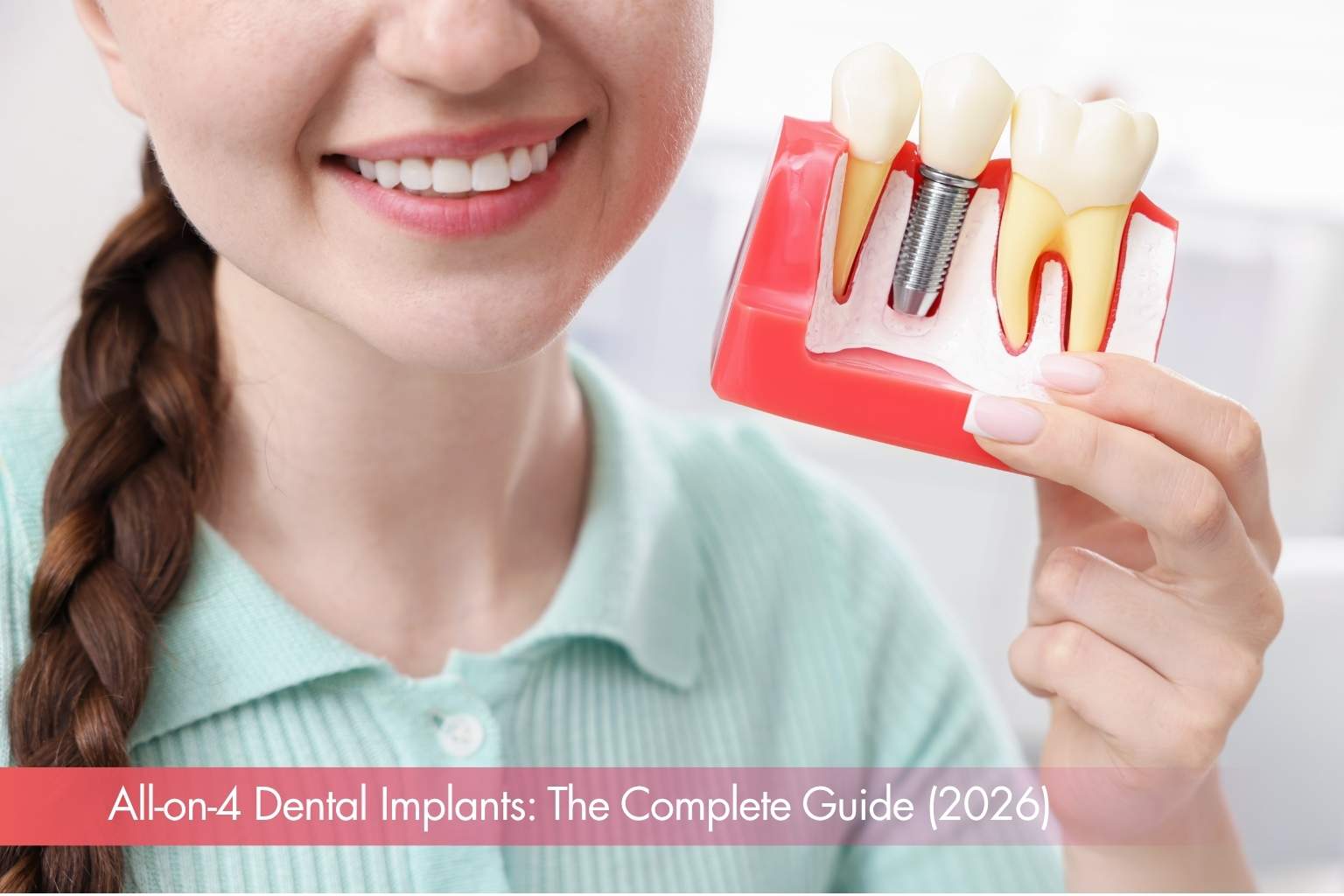
If you're missing most or all of your teeth in one jaw, All-on-4 dental implants let you walk out with a full, fixed set of new teeth supported by just four implants — often on the same day. No dentures to remove at night, no adhesive, no bone graft in most cases. Here's everything to know before you book a consultation.
All-on-4 dental implants replace a full arch of missing teeth using four strategically angled titanium implants topped with a fixed prosthetic bridge. Most patients get temporary fixed teeth the same day as surgery, with permanent teeth fitted 3–6 months later once healing is complete. In the UK, private treatment typically costs £9,000–£18,000 per arch; NHS funding is rarely available outside specific medical circumstances.
Ready to find out if you're a candidate? Book a consultation to get a personalised assessment and quote.
What are All-on-4 dental implants?
All-on-4 is a full-arch tooth replacement technique. Instead of placing one implant per missing tooth — which can mean six or eight implants per jaw — a dentist places just four implants at carefully calculated angles, then attaches a complete arch of prosthetic teeth to them.
The name describes the ratio: all of your teeth on that arch, supported by 4 implants. The two back implants are angled forward, which lets them anchor into denser bone at the front of the jaw and avoids the sinus cavities (in the upper jaw) or nerve canals (in the lower jaw) that often rule out traditional implants for people who've lost bone density.
It's a treatment concept, not a single manufacturer's product, though it was popularised by Nobel Biocare in the early 2000s and refined by Dr. Paulo Maló. Today most implant systems offer a version of it.
At a glance: All-on-4 vs dentures
| Feature | All-on-4 Implants | Removable Dentures |
|---|---|---|
| Fixed in Place | ✔ Yes | ✘ No — Removed Daily |
| Adhesive Needed | ✔ No | Often Required |
| Bite Force | Close to Natural Teeth | Reduced, Especially Lower Dentures |
| Bone Preservation | ✔ Yes — Implants Stimulate the Jawbone | ✘ No — Bone Continues to Shrink Over Time |
| Fixed Teeth Timeline | Temporary Bridge Fitted the Same Day as Surgery | Immediate, but Not Fixed |
| Typical Lifespan | Implants: Lifetime Prosthesis: 10–15 Years | Relining or Replacement Every 5–8 Years |
How the procedure works
- Consultation and 3D imaging. A CT scan maps your jawbone, nerves, and sinuses so the surgeon can plan implant position and angle before you're in the chair.
- Implant placement. Four titanium implants are surgically placed into the jawbone — typically under local anaesthetic, sometimes with sedation.
- Same-day temporary teeth. Because the implants are angled for immediate stability, a temporary fixed bridge can usually be fitted the same day, so you're not without teeth during healing.
- Healing (osseointegration). Over the following 3–6 months, the implants fuse with the bone. You'll be on a modified diet during this stage.
- Final prosthesis. Once healing is confirmed, the temporary bridge is replaced with a custom, permanent set of teeth, typically made from zirconia or an acrylic-titanium hybrid.
Am I a candidate for All-on-4?
All-on-4 was specifically developed to work for people who'd otherwise be turned away from implants. You may be a good candidate if you:
- Are missing most or all teeth in one or both jaws
- Currently wear full or partial dentures and want a fixed alternative
- Have experienced bone loss that would normally require a bone graft before traditional implants
- Are in reasonably good general health (uncontrolled diabetes, active gum disease, or heavy smoking can affect candidacy — your dentist will assess this individually)
The clearest way to know is a consultation and scan — no article can substitute for an in-person assessment of your bone volume and oral health.
All-on-4 vs traditional dental implants
Traditional implant-supported bridges typically use one implant per 2–3 missing teeth, which can mean 6–8 implants per arch and, for many patients, a bone graft first to build up thin jawbone. All-on-4 was designed around exactly that problem: by angling the back implants, it uses the bone that's already there, which is why it can often skip grafting and deliver a fixed set of teeth in a single day rather than over many months.
That trade-off — fewer implants, faster treatment, but a full-arch prosthesis rather than tooth-by-tooth replacement — is the right call for full-mouth cases and the wrong one for patients only missing a single tooth. If that's your situation, single tooth implant cost is the more relevant starting point.
All-on-4 vs All-on-6 Dental Implants
All-on-6 is the same concept with two extra implants for additional support, generally recommended when a patient has enough bone to place them and wants the added long-term stability, particularly in the upper jaw. It costs more and takes longer, and isn't necessary for everyone.
| All-on-4 | All-on-6 | |
|---|---|---|
| Number of implants | 4 | 6 |
| Bone requirement | Lower — works with less available bone | Higher — needs more bone volume |
| Typical cost | Lower | Higher |
| Added stability | Good | Slightly higher, especially upper jaw |
| Best suited to | Most full-arch cases | Cases with less bone density or higher bite-force needs |
We've broken this down in more depth on our All-on-4 vs All-on-6 comparison page.
All-on-4 vs implant-retained dentures
Both use implants as anchors, but implant-retained (snap-in) dentures are removable, while All-on-4 is permanently fixed in place by the dentist — you don't take it out to clean it. Snap-in dentures are usually cheaper and can be a stepping stone toward a fixed solution later. See our full comparison of All-on-4 versus implant dentures.
How much do All-on-4 dental implants cost?
Based on current UK market pricing, private All-on-4 treatment generally runs £9,000–£18,000 per arch, with £12,000–£15,000 the most common range for a single arch. Treating both the upper and lower jaw typically falls between £20,000 and £30,000+. Central London and Harley Street clinics tend to sit toward the top of that range; regional practices are often lower.
That's a wide spread because cost depends heavily on the clinic, the prosthesis material (acrylic hybrid vs. zirconia), whether sedation is used, and case complexity — so treat any published range, including this one, as a starting point rather than your actual price.
(Figures reflect general UK private-practice averages reported in 2026. Always confirm current pricing directly with your clinic — request a personalised quote after your scan.)
For the full breakdown — including regional pricing and finance options — see our dedicated All-on-4 cost guide and UK pricing breakdown.
Is NHS funding available?
In the UK, dental implants — including All-on-4 — are rarely covered by the NHS, which generally funds the least expensive way to restore function (typically dentures) rather than implant treatment. There are limited exceptions for cases involving illness, injury, or congenital conditions. We cover what does and doesn't qualify on our NHS and financing page, including private finance plans most clinics offer instead.
What do results actually look like?
Because the final teeth are custom-shaded and shaped to your face, results vary — see real before-and-after cases to get a sense of what's achievable rather than relying on stock photos.
Recovery and aftercare
Most patients manage initial swelling and discomfort with standard pain relief for a few days. You'll follow a soft-food diet for several weeks while the implants integrate, gradually returning to a normal diet. Long-term, All-on-4 is cared for like natural teeth — brushing, specialised flossing tools under the bridge, and regular dental check-ups.
How long do All-on-4 implants actually last?
The titanium implants themselves are designed to be permanent, fusing directly with the jawbone. Independent long-term follow-up studies support this: a 10-year study of All-on-4 mandibular implants reported implant-level survival around 94–98%, with prosthesis (bridge) survival above 99% (PubMed). Studies following patients for up to 18 years have found similarly high implant survival, generally in the low-to-mid 90% range even at that distance.
The prosthetic teeth on top are the part that eventually needs attention — most patients replace or refurbish them after 10–15 years of normal wear, well before the implants themselves are at risk. The most consistently reported risk factor across these studies is smoking, which meaningfully raises the chance of failure.
Is All-on-4 worth it?
For the right candidate — someone facing a full arch of missing or failing teeth — All-on-4 solves problems dentures can't: no slipping, no adhesive, no diet restrictions, and a bite force close to natural teeth. It's a bigger decision than a single filling, which is exactly why it starts with a consultation, not a purchase. If you're ready for the next step, or just want the real numbers for your situation, get in touch for a personalised quote.
Frequently asked questions
What is the difference between All-on-4 and regular implants?
Regular implant bridges usually need one implant per few teeth and often a bone graft first. All-on-4 uses four strategically angled implants to support a full arch without grafting in most cases.
How long does All-on-4 treatment take?
Temporary teeth are typically fitted the same day as surgery. Full healing and the permanent prosthesis usually follow 3–6 months later.
Can I get All-on-4 if I've worn dentures for years?
Yes — long-term denture wearers are among the most common All-on-4 patients, since bone loss from years without teeth is exactly what the angled-implant design is built to work around.
Does All-on-4 hurt?
The surgery is done under anaesthetic, and most patients describe recovery discomfort as similar to a tooth extraction — manageable with standard pain medication for a few days.
How do I know if I need All-on-4 or All-on-6?
It comes down to your bone volume and long-term goals, which your dentist will assess from a CT scan.
How much do All-on-4 dental implants cost?
Private treatment in the UK generally runs £9,000–£18,000 per arch, with £12,000–£15,000 the most common range. Treating both jaws typically costs £20,000–£30,000+. See our full cost guide for a detailed breakdown.
How much is All-on-4 implants in the UK?
Expect £9,000–£18,000 per arch privately (roughly £20,000–£30,000+ for both arches), with London and Harley Street clinics usually at the top of that range. NHS funding is rarely available. Full regional detail is in our UK pricing breakdown.
How long do All-on-4 dental implants last?
The titanium implants are designed to last a lifetime with proper care. The prosthetic teeth on top typically need replacing after 10–15 years of normal wear.
Can All-on-4 implants fail?
Like any implant, failure is possible but uncommon — long-term studies report implant survival generally above 90%, even at 10+ years. Smoking and uncontrolled diabetes are the two factors most consistently linked to higher failure risk.
What are the downsides of All-on-4 dental implants?
It's still surgery, with standard risks like swelling, infection, or rare nerve/sinus irritation. There's a temporary adjustment period for speech and diet, the fixed bridge needs meticulous daily cleaning to avoid gum inflammation, and because one bridge relies on all four implants, a problem with one can affect the whole arch. It's also a higher upfront cost than dentures.
Can smokers get All-on-4 implants?
Smoking isn't an automatic disqualifier, but it does raise the risk of complications and implant failure. Most dentists will discuss quitting, or at least cutting down, as part of the treatment plan.
Are All-on-4 implants removable?
No — that's the main difference from snap-in dentures. All-on-4 is fixed in place by the dentist; you don't take it out to clean it, though you'll use specific tools to clean under the bridge.
Is sedation available for the procedure?
Most clinics offer sedation options alongside local anaesthetic, from mild relaxation up to general anaesthetic for more anxious patients — ask your clinic what's available.
What is the newest dental implant technique?
As of 2026, the field is moving toward fully digital, guided surgery — CBCT scanning, 3D-printed surgical guides, and in some clinics real-time navigation or robotic assistance. For patients with bone loss too severe even for All-on-4, zygomatic implants (anchored in the cheekbone) are the newest alternative. All-on-4 remains one of the most established full-arch techniques, now typically planned using these same digital tools.
This article is for general information and doesn't replace an in-person dental assessment. Candidacy for All-on-4 depends on your individual bone structure and health history — a consultation and scan are the only way to confirm suitability. Cost figures are general UK market indicators for 2026, not a quote from any specific clinic.