By Dr Mudasir Ur Rehman, GDC No. 196599 — Lead Dentist, Robinhood Dental Practice, Hall Green, Birmingham.
Proudly serving Birmingham and the surrounding areas for over 20 years.
Last reviewed: 12 September 2026Most weeks, a patient sits in my chair and asks some version of the same question: "Doctor, do I need a crown or a veneer?" It's usually framed as a preference — like choosing between two paint colours. But in most cases, the tooth has already made the decision. A veneer and a crown solve two completely different problems, and using the wrong one either wastes your money or leaves a weak tooth unprotected.
I've fitted both for thousands of patients across Birmingham, and the confusion is almost never about vanity — it's that nobody's ever actually laid out the difference in plain terms. So here it is, properly explained, with real Birmingham pricing and no vague ranges.
The short answer
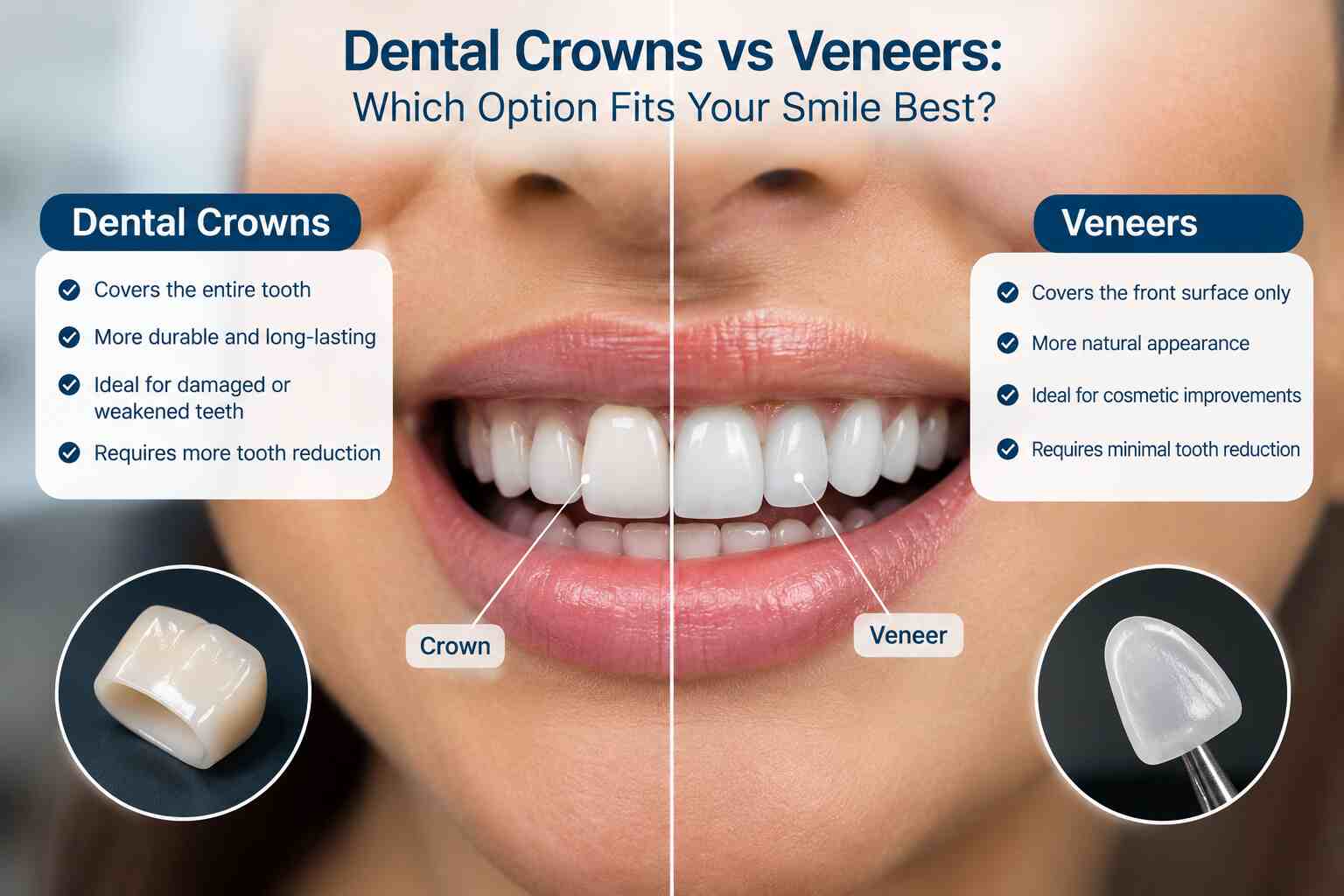
A veneer is a thin porcelain shell bonded to the front of a healthy tooth to change how it looks. A crown is a full-coverage cap that rebuilds a tooth that's cracked, heavily filled, decayed, or root-treated. If your tooth is structurally sound and you simply don't like its colour, shape, or minor chips, a veneer will do the job. If the tooth has lost real structure, a veneer won't hold — you need a crown.
| Factor | Veneer | Crown (also called a "cap") |
|---|---|---|
| What it covers | Front (visible) surface only | The entire tooth, 360° down to the gumline |
| Tooth structure removed | Approx. 0.3–0.7mm from the front surface — roughly a fingernail's thickness | Approx. 1.5–2mm from all sides, to make room for a full cap |
| Used for | Cosmetic correction on an otherwise healthy tooth | Restoring strength on a damaged, decayed, cracked, or root-treated tooth |
| Common materials | Porcelain (or composite resin for a cheaper, shorter-lived option) | Zirconia/Emax, porcelain-fused-to-metal (PFM), or full metal |
| Price at Robinhood Dental | £650 per tooth | £495 (Metal) / £595 (PFM) / £695 (Zirconia/Emax) |
| Typical lifespan | 10–15 years, longer with excellent care | 10–15 years on average; zirconia and Emax crowns often reach 15–20 years |
| NHS availability | Almost never funded — classed as cosmetic | Available under NHS Band 3 (£332.10, April 2026 rate) when clinically necessary |
| Visits needed | Usually 2 — prep and bonding | Usually 2 — prep with temporary crown, then permanent fit |
What's the actual difference between a crown and a veneer?
What is a dental veneer?
A veneer is a very thin shell — usually porcelain — that's bonded to just the front surface of a tooth. Think of it as re-facing a wall rather than rebuilding it. We lightly buff the enamel to give the porcelain something to bond to, take an impression, and send it to the lab. Underneath, your own tooth stays mostly intact. Veneers exist purely to change appearance: colour, shape, minor gaps, small chips, or teeth that look slightly uneven.
What is a dental crown — and is a "cap" the same thing?
Yes — "cap" is simply the everyday word for a crown; dentists say crown, patients often say cap, and both mean exactly the same treatment. A crown covers the whole visible tooth, from the chewing surface down to the gumline, the way a knight's helmet covers a head rather than just the face. We reshape the tooth on every side, then fit a cap over it. Crowns exist to restore strength and function to a tooth that's already lost a meaningful amount of its own structure.
That's the whole distinction in one line: a veneer is cosmetic re-facing on a healthy tooth; a crown is structural rebuilding on a compromised one. They are not two flavours of the same treatment, and one cannot substitute for the other.
The 4 things that actually decide it — not personal preference
I don't pick between a crown and a veneer based on what looks nicer in the brochure. I look at four things:
- How much healthy tooth structure is left. A tooth with a large old filling, a crack, or heavy decay has less to hold a thin veneer stable — it needs full support.
- Whether the tooth has had root canal treatment. Root-treated teeth become more brittle over time and almost always need a crown to prevent fracture, regardless of how they look.
- What you're actually trying to fix. Colour, minor shape, small gaps → cosmetic, veneer territory. Pain, sensitivity, visible cracks, a tooth that's broken down → structural, crown territory.
- Your bite and grinding habits. Heavy grinders (bruxism) put more shear force on thin porcelain edges, which can make veneers more prone to chipping unless a nightguard is part of the plan.
Veneers: when they're the right call
Veneers usually make sense when:
- The tooth is structurally healthy — no large fillings, no decay, no cracks
- You're unhappy with staining that whitening hasn't fully corrected
- Teeth are slightly chipped, uneven in length, or oddly shaped
- There are small gaps you'd rather close than have orthodontics for
- You want to preserve as much of your natural tooth as possible
What veneers can't do: they won't save a tooth that's actively decaying underneath, they won't strengthen a tooth that's already cracked, and if the tooth needs a filling that covers more than a small area, a veneer sitting on top of it is not a stable long-term fix. A veneer is an artist, not a surgeon — it changes how a healthy tooth looks; it doesn't rescue one that's in trouble.
Crowns: when your tooth needs one, not a makeover
A crown is usually the right treatment when:
- The tooth has had root canal treatment and needs protection from fracture
- A large portion of the tooth is already filled and there isn't enough natural structure left
- The tooth is visibly cracked or fractured
- Significant decay has been removed and the remaining tooth needs rebuilding
- A back tooth needs to withstand full biting and chewing force
Crowns vs veneers on front teeth specifically
This is where most of the genuine confusion happens, because front teeth are exactly where people care most about appearance. The honest answer: front teeth follow the same rule as any other tooth. If a front tooth is healthy and you simply don't like its shape or colour, a veneer gives a beautifully natural result while preserving far more of your own enamel. But if that same front tooth has had a root canal, has a large old filling, or is fractured, a veneer will not hold up — you need a crown, and modern zirconia or Emax crowns are genuinely difficult to distinguish from a natural front tooth. Appearance is not the deciding factor on front teeth any more than it is on back ones; tooth condition is.
A third option worth knowing about: composite bonding
If your only concern is a small chip, a gap, or minor unevenness — and you're not ready for the cost or lab wait of a veneer — composite bonding is worth considering first. It's tooth-coloured resin sculpted directly onto the tooth in a single visit, from £320 per tooth, with no lab stage. It doesn't last as long as porcelain and isn't a substitute for a crown on a structurally weak tooth, but for small cosmetic fixes it's a genuinely useful lower-cost middle step.
Cost: crowns vs veneers in Birmingham
At Robinhood Dental Practice, a porcelain veneer is £650 per tooth — one fixed price, not a vague "from" figure. Crowns depend on material: £495 for a full metal crown (strong, best suited to back molars where it won't show), £595 for porcelain-fused-to-metal, or £695 for zirconia or Emax, which give the most natural, tooth-like appearance and are our recommendation for anything visible when you smile.
On the NHS, a crown falls under Band 3 (£332.10 as of the April 2026 England rate) when it's clinically necessary — the material fitted is whichever the dentist judges clinically appropriate, which on the NHS is often a less cosmetic option than private zirconia or Emax. Veneers are almost never available on the NHS, because they're classed as cosmetic rather than clinically necessary, regardless of how much they'd improve your confidence.
For the full cost breakdown by material, plus what changes the price (root canal first, core build-ups, and so on), see our dedicated dental crown cost guide.
What actually happens in the chair
| Stage | Veneer | Crown |
|---|---|---|
| Visit 1 | Discuss shade and shape, lightly prepare the front surface, take a digital scan or impression | X-ray to check the tooth beneath, reshape the tooth on all sides, take an impression, fit a temporary crown |
| In between | Porcelain veneer made in the lab, usually around 1–2 weeks | Permanent crown made in the lab, usually around 1–2 weeks |
| Visit 2 | Veneer is bonded permanently and bite is checked | Temporary crown removed, permanent crown cemented and bite checked |
| Anaesthetic | Often minimal, sometimes not needed given how little is removed | Local anaesthetic is standard for the reshaping stage |
Both procedures are painless under local anaesthetic, and most patients describe the recovery as a few days of mild sensitivity to hot or cold rather than any real discomfort.
How long each one lasts — and how to make them last longer
In my experience, well-placed porcelain veneers reliably last 10–15 years, and I've seen well-maintained ones go longer. Crowns follow a similar pattern: 10–15 years is a realistic average, and zirconia or Emax crowns on patients who keep up with hygiene visits and don't grind at night regularly reach 15–20 years. Neither is "permanent" — but both are a long-term investment if you look after them.
Getting the most out of either:
- Brush twice daily and clean between teeth with floss or interdental brushes, especially at the margin where the restoration meets your natural tooth
- Avoid biting ice, pen lids, or anything you wouldn't want to test a fingernail against
- If you grind your teeth at night, a nightguard is genuinely the single biggest thing you can do to protect either a crown or a veneer — we fit these from £195
- Keep up with your 6-monthly check-ups so any early issues are caught before they become expensive ones
When to call us straight away
Most crown and veneer problems are minor and fixable — but a few signs need same-day attention rather than waiting for your next routine check-up:
- Pain or a "high" feeling when biting down on a new crown
- A dark line, gap, or softness appearing at the gumline of a crowned or veneered tooth
- A veneer that's chipped, cracked, or come away from the tooth
- A crown that's come off completely — keep it safe and call us; we can often re-cement it same-day for £75
- Swelling, throbbing, or a bad taste around a crowned tooth, which can point to infection underneath
If any of these apply to you, call Robinhood Dental Practice on 0121 744 1484 rather than waiting.
Frequently asked questions
Ready to find out which one your tooth needs?
Book a New Patient Examination for £25, or an online consultation (including assessment and X-rays) for £35, and we'll give you a straight answer — not a guess — along with a clear, itemised price before you commit to anything.
📍 Robinhood Dental Practice, 1491 Stratford Road, Hall Green, Birmingham B28 9HT
📞 0121 744 1484 | Open 7 days a week | Est. 1975
Medical disclaimer: This article is written for general information and does not replace an in-person dental examination. Crown and veneer suitability depends on your individual tooth structure, bite, and oral health, which can only be properly assessed in the chair with X-rays where needed. Content reviewed by Dr Mudasir Ur Rehman, GDC No. 196599. If you're experiencing pain, swelling, or a damaged restoration, please contact the practice directly rather than relying on this guide alone.