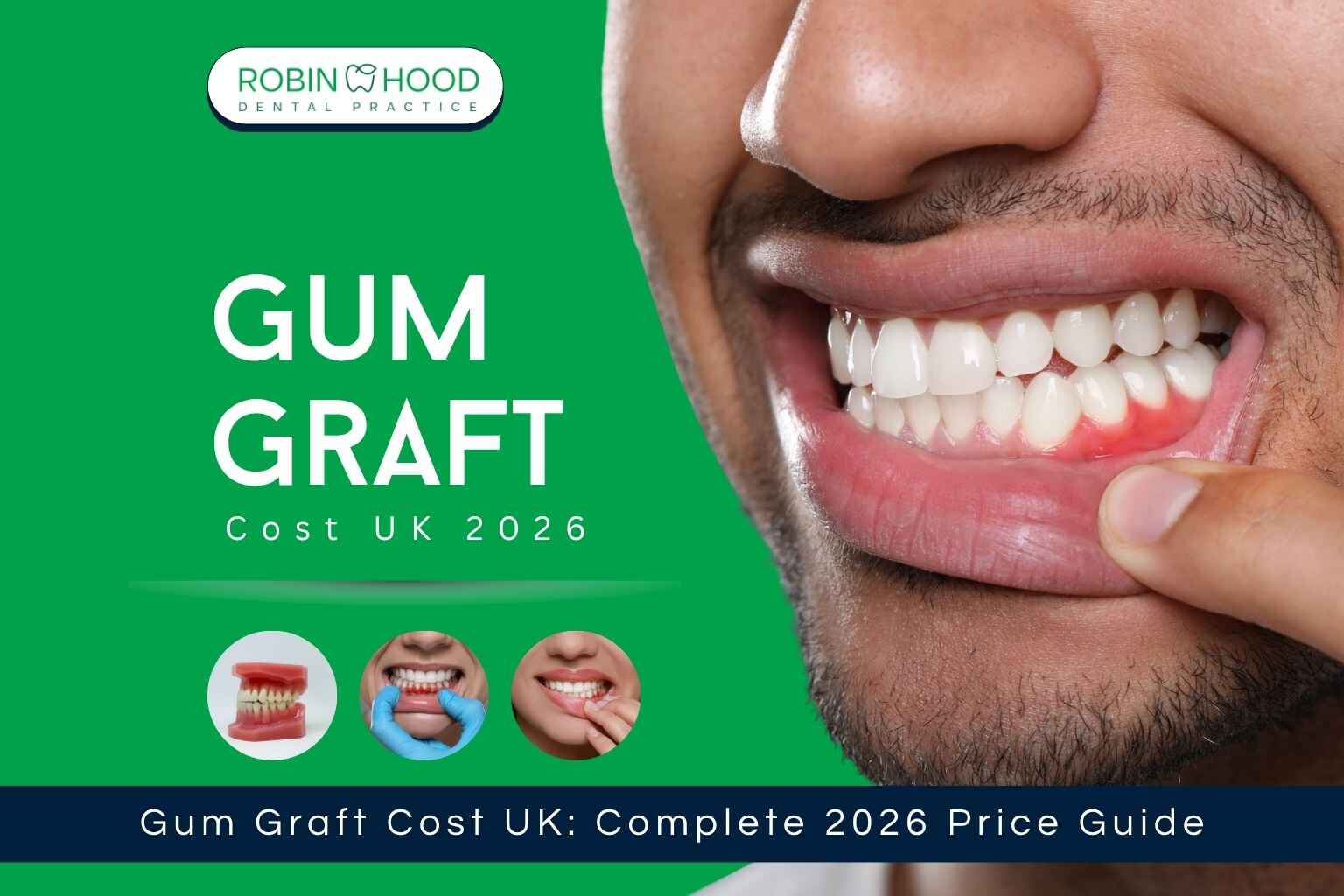
Last updated: August 10, 2026
If your gums have started pulling away from your teeth, the first question is usually "how much is a gum graft going to cost me?" — and the honest answer is that it depends on more than most price guides let on. A single-tooth graft can cost as little as £400, while a full-quadrant graft with a specialist periodontist can run past £1,500. Neither figure is wrong, but neither tells you which one applies to you.
This guide breaks gum graft surgery cost down by technique, by severity, and by NHS versus private treatment, so you can see exactly where your own case is likely to fall — plus what's driving the price, what gum graft before and after results typically look like, and what your non-surgical options are before you commit to surgery at all.
Quick Answer: What Does a Gum Graft Cost in the UK?
| Treatment Route | Typical UK Price Range | Notes |
|---|---|---|
| NHS (Band 2, England) | £28.90 (interim charge)* | Only if clinically necessary; long waiting lists; not offered by all NHS practices |
| Private — single tooth | £400 – £750 | Free gingival or connective tissue graft, one site |
| Private — one quadrant (up to ~4 teeth) | £750 – £1,495 | Multiple adjacent teeth treated in one session — this is the typical range if you're pricing a gum graft for 4 teeth |
| Private — complex/severe recession | £1,200 – £1,800+ | Specialist periodontist, donor tissue, larger graft area |
| Pinhole surgical technique (multiple teeth) | Variable — often less than traditional grafting per tooth treated | Not suitable for every case; ask your dentist if you qualify |
NHS band charges are set nationally in England and reviewed periodically. Scotland, Wales, and Northern Ireland each set their own NHS dental charges separately — see the NHS pricing section below. Confirm the current rate and your eligibility directly with the practice, as gum grafts are not automatically included in every NHS course of treatment.
Why the Price Varies So Much: The Real Cost Drivers
Most gum graft price guides quote a range and stop there. The range exists because five factors combine differently for every patient:
1. Graft Technique
- Free gingival graft — tissue taken from the roof of the mouth and stitched directly onto the recession site. The most established technique, and often the most cost-predictable.
- Connective tissue graft — tissue taken from beneath the surface layer of the palate, typically used for root coverage where appearance matters. Slightly more technically demanding, which can affect fees.
- Pedicle (lateral) graft — tissue is shifted from next to the affected tooth rather than the palate, reducing the number of surgical sites and sometimes the price.
- Pinhole surgical technique — a newer, less invasive gum graft technique that can treat several teeth through small entry points without a donor site, which may reduce overall cost when multiple teeth are affected — but it isn't suitable for every level of recession.
- Allograft/xenograft — donor tissue (human or animal-derived) instead of your own, used when there isn't enough healthy palate tissue to harvest. Material costs tend to add to the fee.
- Guided Tissue Regeneration (GTR) — used where bone loss has occurred alongside recession; a membrane is placed to encourage the body to regenerate lost tissue and bone, sometimes combined with a graft.
2. Number of Teeth and Sites Involved
A single exposed root is a very different procedure to recession across a full quadrant. Multi-tooth grafting in one session — for example, a gum graft covering 4 teeth in the same area — is usually cheaper per tooth than treating each one separately over multiple visits, because the surgical setup cost is shared. As a rough guide, a 4-teeth case is more likely to fall into the quadrant pricing band (£750–£1,495) than the single-tooth band above.
3. Severity of Recession
Recession is generally staged from mild (barely visible root exposure) to severe (significant root exposure with bone loss). More advanced recession needs a larger graft, sometimes combined with bone grafting, which increases both the surgical time and the fee.
4. Who's Performing the Surgery
General dentists, dentists with a special interest in periodontics, and specialist periodontists all perform gum graft surgery, and fees generally increase with the specialist's level of training. For complex or high-visibility cases (especially front teeth), a specialist periodontist is usually worth the higher fee — get a second opinion if your case is being quoted by a general dentist and it's a complicated one.
5. What's Included in the Quote
Ask whether the quoted price covers the consultation, any necessary X-rays, the graft itself, follow-up review appointments, and pain relief. Some practices quote the surgical fee alone and add the rest afterwards — always ask for a full written quote before you commit.
Periodontal Assessment: What Happens Before You're Quoted
Before any dentist gives you a firm gum graft price, they should assess the recession properly rather than pricing from a glance. This typically includes a gum screening (BPE), probing to measure how much attachment has been lost around each tooth, and X-rays to check the supporting bone level. This assessment determines the severity staging — and that staging, more than anything else, is what a genuinely accurate quote is based on.
NHS vs Private: What's Actually Available
Gum grafting sits in a grey area on the NHS. It's classed as Band 2 treatment when it's clinically necessary — meaning your dentist judges that the recession is putting the tooth at risk, not simply that you'd prefer the gum to look different. In practice:
- Many NHS practices don't offer gum grafting in-house and will refer you to a hospital periodontology department, which usually means a significantly longer wait.
- If the recession is assessed as cosmetic rather than a health risk, NHS treatment typically won't be offered at all, and you'll be advised to go private.
- Private treatment gives you a choice of technique, a choice of specialist, and a much shorter wait — but you're paying the full cost of £400–£1,800+ depending on the factors above.
NHS Gum Graft Pricing Across the UK
NHS dental charges are set separately by each UK nation, so "gum graft cost UK NHS" doesn't have a single answer if you're outside England:
- England — Band 2 charge, currently around £28.90 (interim rate; confirm current NHS England banding before quoting)
- Wales — set separately via NHS Wales dental charges; check the current Band 2 rate at nhs.wales
- Scotland — most NHS dental treatment in Scotland is charged on a different percentage-based system; check current rates via NHS Inform
- Northern Ireland — set separately via HSC dental charges; check the current Band 2 rate via hscni.net
If you're not sure which category you fall into, that's a question worth asking directly at your consultation — it's the single biggest factor in what you'll actually pay.
Do You Actually Need a Graft? Non-Surgical Alternatives and Their Cost
Surgery isn't always the first step. Depending on how advanced your recession is, one of these may be appropriate — and significantly cheaper:
| Option | Typical Cost | Best For |
|---|---|---|
| Desensitising fluoride varnish | From around £20 | Mild sensitivity, very early recession, no active disease |
| Improved brushing technique + soft brush | Minimal / included in hygiene visit | Recession caused by aggressive brushing, not yet progressed |
| Hygiene appointment + deep clean (scaling and root planing) | Per-quadrant fee, ask practice for current pricing | Recession linked to gum disease — treating the cause first |
| Composite bonding over the exposed root | £150 – £350 per tooth | Covering an exposed root cosmetically without grafting |
| Gum graft surgery | £400 – £1,800+ | Moderate to severe recession, ongoing root exposure risk, or where bonding isn't durable enough |
An important sequencing point that's often skipped in cost guides: if gum disease is the underlying cause of your recession, treating and stabilising that first is essential. A graft placed over gums that are still actively inflamed is far less likely to hold — so your dentist may recommend hygiene therapy before gum graft surgery is even discussed, regardless of which technique you eventually choose.
Signs You May Need a Gum Graft
- Teeth that look longer than they used to, or a visibly uneven gum line
- Sensitivity to hot, cold, or sweet foods at the gum line
- A notch or groove felt at the base of a tooth, where root has become exposed
- Gums that bleed easily or look thin and fragile around specific teeth
- Previous gum disease treatment that has left lasting recession
If any of these apply, book a consultation rather than guessing — recession that's caught early is cheaper and simpler to manage than recession left to progress.
What Happens During Gum Graft Surgery
Gum graft surgery is carried out under local anaesthetic, so the area is fully numb and the procedure itself isn't painful. Depending on the technique, your dentist or periodontist will either take a small piece of tissue from the roof of your mouth or reposition tissue from nearby, then secure it over the exposed root with sutures. Most single-site procedures take between 45 and 90 minutes.

Recovery Timeline and Healing Stages: What to Expect Day by Day
| Timeframe | What to Expect |
|---|---|
| Day 1 (day of surgery) | Numbness wears off after a few hours; mild soreness begins. Stick to cool, soft foods. Avoid touching or rinsing the area. |
| Days 2–3 | Peak discomfort and swelling — the graft site typically looks its most red and puffy at this stage — manageable with over-the-counter painkillers. Continue a soft diet, avoiding anything crunchy, spicy, or very hot. |
| Days 4–7 | Swelling and tenderness gradually reduce and the graft site starts to look less raw. Gentle rinsing with a prescribed or salt-water mouthwash may begin if advised. Avoid brushing directly over the graft site. |
| Week 2 | Initial healing of the graft site — colour usually starts settling toward a more natural pink. A review appointment is typically scheduled to check integration. |
| Weeks 3–4 | Tissue continues to mature and blend with surrounding gum, visually becoming harder to distinguish from the natural gumline. Normal brushing of the area can usually resume, guided by your dentist. |
| 3 months+ | Full maturation of the graft — this is generally when the final, settled appearance is assessed. Long-term success depends on good oral hygiene and regular check-ups from this point on. |
When to contact your dentist: persistent or worsening pain after day 3–4, unusual swelling, fever, or the graft site appearing to separate from the surrounding gum are all reasons to get in touch promptly rather than waiting for your scheduled review.
Gum Graft Before and After: What Results Typically Look Like
"Before" is usually visible root exposure — a longer-looking tooth, an uneven gumline, or a notch where the root meets the gum. Immediately "after" surgery, the treated area looks red, slightly swollen, and more noticeable than the original recession while it heals — this is normal and not the final result. By around 4 weeks, the graft has usually settled into a more natural colour and texture; by 3 months, most patients see the final outcome, with the treated tooth looking proportionate again and the root coverage stable.

How much root coverage is achievable varies by case — mild recession with intact bone often achieves full coverage, while more advanced recession may only achieve partial coverage, which is something worth asking about at consultation rather than assuming.
How Long Do Gum Grafts Last?
With good oral hygiene, regular dental visits, and gentle brushing technique, a successful gum graft can last for many years — often permanently at the treated site. The graft itself doesn't guarantee protection against future recession elsewhere in the mouth, particularly if the original cause (aggressive brushing, ongoing gum disease, or teeth grinding) isn't also addressed, and a further graft can occasionally be needed at a different, untreated site down the line.
Financing Your Gum Graft
Because private gum grafting is a meaningful one-off cost, ask your practice whether interest-free payment plans are available — many practices now offer to spread the cost over several months, which can make specialist treatment more accessible without delaying care while recession continues to progress.
Gum Graft — Frequently Asked Questions
The procedure itself is performed under local anaesthetic and isn't painful. Some soreness and swelling in the days afterwards is normal and manageable with over-the-counter painkillers.
Single-tooth private grafts typically range from around £400 to £750, though this can be higher for a specialist periodontist or a more complex case.
Treating several adjacent teeth — such as a gum graft for 4 teeth in the same quadrant — is usually quoted as one session rather than four separate single-tooth fees, typically falling in the £750–£1,495 range. It usually works out cheaper per tooth than treating each site individually across multiple visits, because the surgical setup cost is shared.
It's possible if your dentist assesses the recession as a genuine risk to the tooth, classed as Band 2 treatment, though availability and waiting times vary and many NHS practices refer this out to a hospital periodontology department. NHS charges also differ across England, Scotland, Wales, and Northern Ireland.
It depends on your policy and whether the treatment is considered clinically necessary rather than cosmetic. Cover for gum grafting specifically varies by provider, so it's worth checking directly with them before booking.
The pinhole surgical technique treats recession through small entry points without taking tissue from the palate, which can make it less invasive and, in multi-tooth cases, sometimes more cost-effective per tooth than traditional grafting. It isn't suitable for every level of recession, so it's worth asking at consultation whether you're a candidate.
It depends on the severity and location of the recession. Composite bonding can cosmetically cover an exposed root but doesn't address ongoing recession risk the way a graft does — this is worth discussing directly with your dentist at consultation.
Initial healing takes around one to two weeks, with full tissue maturation — and the final settled appearance — over roughly three months. Most people return to normal eating and brushing within two to four weeks, guided by their dentist's advice.
Many grafts last permanently at the treated site with good oral hygiene and regular dental visits. A further graft is more likely to be needed at a different site than the original one, if the underlying cause of recession elsewhere in the mouth isn't managed.