Medically reviewed by Dr Mudasir Ur Rehman, GDC No. 196599 — Robinhood Dental Practice, Hall Green, Birmingham Published: 12 August 2026 · Last updated: 25 August 2026
In my practice in Hall Green, receding gums are one of the concerns patients raise most often — usually after noticing a tooth "looks longer" than it used to, or a sudden twinge when they drink something cold. Gum recession is a gradual change, so by the time it's noticeable, it's often been developing quietly for a while.
The reassuring part is that gum recession caught early is simple and inexpensive to manage. Left untreated, it tends to progress and the options narrow. This guide walks through what causes receding gums, how to recognise the different stages, what you can genuinely do at home to stop it getting worse, and the full range of professional treatment routes — from a routine clean through to gum graft surgery.
In short: gum recession is when gum tissue pulls back and exposes more of the tooth or root. It doesn't grow back on its own, so the main aim of any gum recession treatment is to stop it progressing and, where appropriate, restore coverage surgically. Gum disease is the leading cause, though brushing habits, smoking and teeth grinding all play a part too.
What Is Gum Recession?
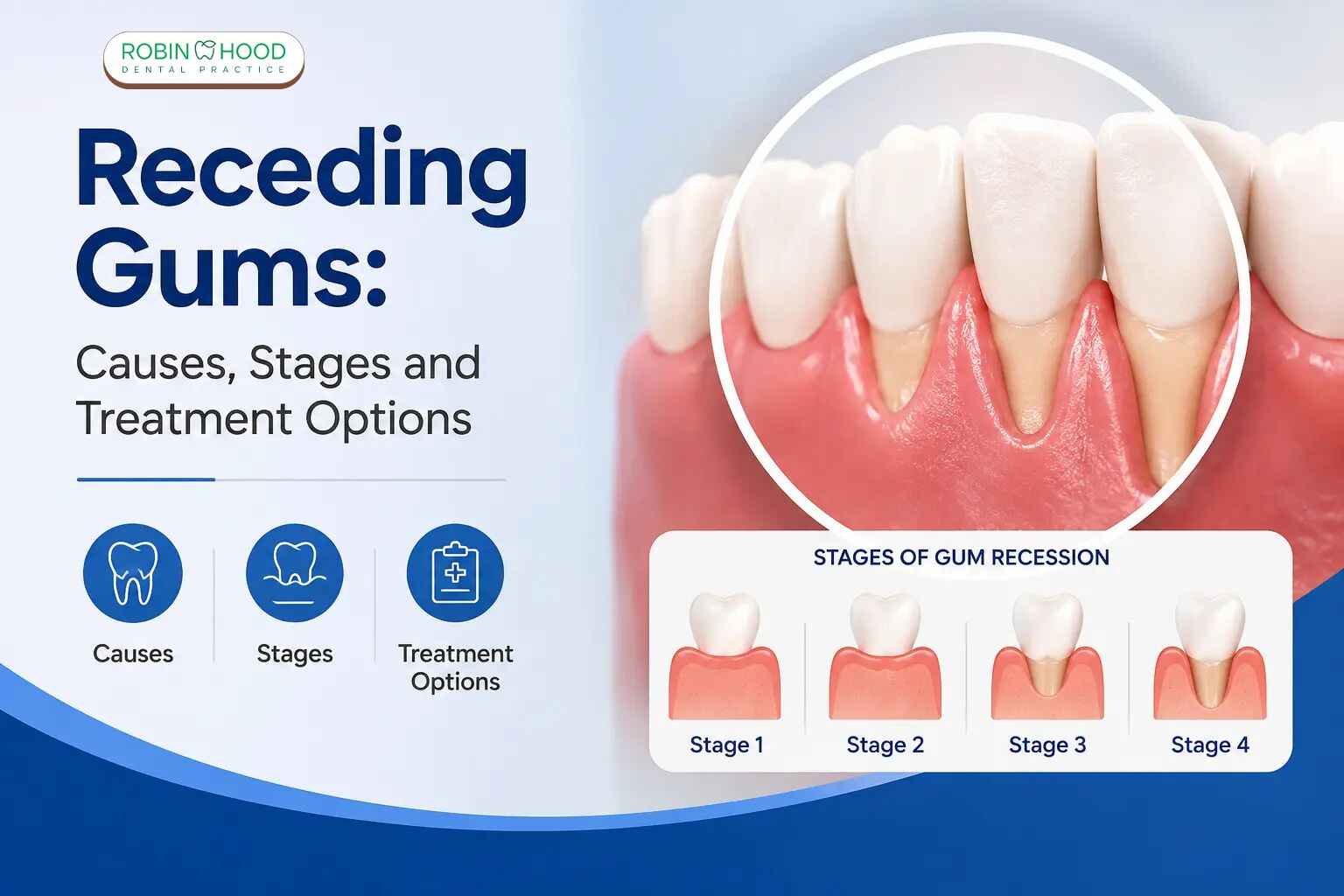
Gum recession happens when the soft tissue surrounding a tooth wears away or pulls back, exposing more of the tooth's surface — and eventually its root. As the gum line moves, small gaps or "pockets" open up between the tooth and the gum, which gives bacteria somewhere new to collect. Left alone, that ongoing bacterial buildup tends to make the recession worse, which is why it's rarely a problem that stays still.
Signs of Receding Gums You Shouldn't Ignore
Recession is usually painless in its early stages, so the signs are easy to miss. Common signs include:
- Teeth that look noticeably longer than they used to
- Sensitivity to hot, cold or sweet food and drink at the gum line
- A notch or groove you can feel with your tongue where the root has become exposed
- A visible colour change at the base of the tooth — exposed root tends to look more yellow than the enamel above it
- Gums that bleed easily when brushing or flossing
- An uneven gum line, where some teeth appear more affected than others
- Gaps opening up between teeth that weren't there before
Receding Gum on One Tooth – Is That Normal?
It's genuinely common to notice recession on a single tooth rather than across the whole mouth. This usually points to a localised cause rather than widespread gum disease — brushing harder on one side, a tooth sitting slightly outside the normal arch (which leaves it with naturally thinner gum and bone coverage), an ill-fitting denture clasp, a lip or tongue piercing rubbing against that spot, or old trauma to the area. A single-tooth recession is still worth having checked, because left unaddressed it can progress just like more widespread recession.
Stages of Gum Recession: How Severe Is Yours?
There's no single scale patients are told day-to-day, but I generally think of recession in three broad stages — knowing roughly where you sit helps you judge how urgently to get it checked:
- Early/mild — a tooth looks very slightly longer than its neighbours, or you notice a small notch at the gum line. Sensitivity may just be starting.
- Moderate — the root is visibly exposed, sensitivity is more noticeable, and the gap between teeth near the gum line often looks larger.
- Advanced/severe — significant root exposure, sometimes with visible bone loss on X-ray, and a real risk to the tooth's long-term stability if left untreated.
Only a dentist can tell you exactly where you fall on this — a mirror check is useful for noticing that something's changed, not for diagnosing how severe it is.
How Common Is Gum Recession in the UK?
Gum recession is genuinely common, not a rare complication. The Adult Oral Health Survey 2023 — the first full clinical survey of adult oral health in England in over a decade — found that interdental recession was present in around one in five dentate adults examined, while over 40% had periodontal pocketing of 3.5mm or more, an early clinical marker of gum disease. Taken together with softer indicators like plaque and bleeding, more than nine in ten adults examined showed at least one sign of gum-related problems. Prevalence increases with age, but recession isn't caused by age itself — it's the accumulation of risk factors like plaque, brushing habits and smoking over time. (Source: OHID/NatCen Adult Oral Health Survey 2023)
What Causes Receding Gums?
Recession rarely has a single cause — it's usually a combination of the following, and identifying which applies to you shapes what treatment (and prevention) makes sense.
Gum disease (the leading cause). Gum disease follows a fairly predictable path. Plaque builds up along the gum line; if it isn't removed, the gums become inflamed — this early stage, gingivitis, is reversible with better cleaning and a professional scale and polish. Left untreated, it can progress to periodontitis, where the infection spreads below the gum line and starts to break down the bone and tissue that support the tooth. This stage is not reversible, and it's the most common route to significant recession.
Brushing too hard. A very common cause, particularly in younger patients with otherwise healthy gums. A hard-bristled brush, or a side-to-side scrubbing motion instead of gentle circles, physically wears the gum tissue away over months and years.
Smoking and tobacco use. Smoking reduces blood flow to the gums and weakens the body's ability to fight the bacteria that cause gum disease, so it acts as both a cause and an accelerator of recession — and it also slows healing after any gum treatment.
Teeth grinding (bruxism). Grinding or clenching puts far more force through the teeth and gums than normal chewing. Over time, that extra pressure can weaken the gum's attachment, especially where the tissue is already thin.
Genetics. Some people are simply more predisposed to gum disease and thinner gum tissue regardless of how well they look after their teeth. If close family members have had gum problems, it's worth mentioning at your check-up.
Hormonal changes. Fluctuating hormone levels during pregnancy, the menstrual cycle and menopause can make gums more reactive to plaque than usual, which is why gum inflammation is so common in pregnancy in particular.
Other contributing factors. Misaligned teeth can put uneven pressure on the gum in specific spots; oral piercings can cause localised recession where metal rubs against the gum; and some patients notice mild recession during or after orthodontic treatment, though this is usually minor.
Can Receding Gums Grow Back? The Honest Answer
However you've phrased the question, the honest answer is the same: no, gum tissue does not regenerate on its own once it's lost, the way skin heals after a cut. This is the single most important thing to understand about recession, because it's what makes early action worthwhile.
That said, whether recession can be fixed is a different question with a more encouraging answer. Treatment can't reverse recession naturally, but it can stop it progressing, protect the exposed root from sensitivity and decay, and in many cases restore coverage surgically through a gum graft — sometimes described clinically as reversing the recession through grafting rather than natural regrowth. The earlier recession is caught, the more of these options are realistically on the table.
Can Gum Disease Be Reversed?
It depends on the stage. Gingivitis — early inflammation with no permanent damage yet — is genuinely reversible, typically clearing up with a proper clean and improved hygiene. Once it progresses to periodontitis, some bone and attachment loss has already happened, and that part is not reversible. So yes, if you catch it early; beyond that point, treatment is about stopping it in its tracks, not undoing the damage already done.
Will Periodontal Disease Go Away On Its Own?
No. Periodontal disease is a bacterial infection — it doesn't resolve by itself, and left untreated it typically gets worse. The same applies to earlier-stage gum disease: it needs active treatment, usually a professional clean, to actually stop.
How to Stop Receding Gums Getting Worse
Recession that's already happened won't reverse by itself, but there's a lot you can do to stop it progressing:
- Switch to a soft or ultra-soft brush and use gentle circular motions rather than scrubbing side to side
- Consider an electric toothbrush — many models include a pressure sensor, genuinely useful if you tend to brush harder than you realise
- Clean between your teeth daily with interdental brushes or floss — plaque left between teeth is a major driver of gum disease
- If you smoke, quitting is one of the most impactful changes you can make for gum health specifically
- Ask about a nightguard if you grind your teeth — protecting the gums from that extra force can meaningfully slow recession
- Keep up with regular check-ups — recession is far easier to spot early at a routine appointment than to notice yourself
- Get any active gum disease treated promptly rather than waiting for it to settle on its own
Gum Recession Remedies You Can Try at Home
There's no shortage of home remedies promoted online, and this is worth being straightforward about — some genuinely support gum health, but none of them regrow tissue or reverse recession itself:
- Saltwater rinses — can reduce bacteria and mild inflammation
- Green tea — contains compounds with some evidence for reducing gum inflammation
- Aloe vera gel — may soothe irritated gums when used alongside, not instead of, professional care
- Turmeric paste — traditionally used for its anti-inflammatory properties, though evidence is limited
- Avoiding abrasive or whitening toothpaste on already-exposed roots, which can worsen sensitivity
None of these should delay a dental check-up if you're noticing active recession — they support gum health alongside professional care, not instead of it.
How to Treat Gum Disease at Home (Safely)
The realistic version of home treatment is meticulous daily hygiene, an antibacterial mouthwash if your dentist recommends one, and close monitoring for bleeding or swelling. What home care can't do is remove hardened tartar below the gum line — that requires a professional scale and clean. Home care and professional treatment work together; one doesn't replace the other.
"I Healed My Receding Gums" – What These Stories Really Mean
You'll come across forum posts and blogs describing how someone healed their own receding gums at home. I'd read these with a critical eye. In most cases, what people describe healing is early gum inflammation (gingivitis) rather than established recession, or they've combined home care with a professional deep clean and credited the home remedy alone. If a personal story is what's prompted you to look into this, treat it as a reasonable nudge to book a hygienist appointment — not a substitute for one.
Treatment Options at a Glance
What's right for you depends on how advanced the recession is and what's driving it. Broadly, the options fall into two groups.
Non-surgical options
- Scale and polish — removes plaque and tartar above and below the gum line; often enough on its own for mild cases, and the standard first-line treatment
- Deep cleaning (scaling and root planing) — a more thorough clean below the gum line under local anaesthetic, usually done in sections over a few appointments
- Desensitising treatment — fluoride varnish or similar applied to exposed roots, a common answer to sensitivity without surgery
Surgical options
- Gum graft surgery — tissue (usually taken from the roof of the mouth, or occasionally donor tissue) is used to cover the exposed root; this remains the most established and predictable way to restore gum coverage
- Pinhole surgical technique — a less invasive, scalpel-free alternative for suitable cases, where the gum line is gently repositioned through a small entry point rather than grafted
- Guided tissue regeneration or laser-assisted techniques — for more complex or advanced cases, a specialist periodontist may discuss these; they're less widely available and generally reserved for cases that need more than a standard graft
Cost tends to move in one direction if recession is left unaddressed. What starts as a straightforward, inexpensive fix — improved brushing technique, a scale and polish — can progress to needing deep cleaning, then grafting, and in the worst cases contribute to tooth loss, where replacement options such as implants or bridges cost considerably more than any of the treatments above. Catching recession early isn't just simpler clinically, it's the cheaper path too.
Exact pricing for grafts and the pinhole technique varies by technique, severity and how many teeth are involved — we're happy to give you a written quote after an assessment.
Removal of Gums? Clearing Up a Common Misunderstanding
A surprising number of people search for "gum removal" while researching recession, but these are actually opposite problems. Gum removal — a procedure called a gingivectomy — is used when there's too much gum tissue: excess gum covering the teeth, sometimes called a "gummy smile," or overgrowth from certain medications. Recession is the opposite — not enough gum tissue. If you're dealing with receding gums, you're looking for coverage, not removal, and it's worth mentioning this distinction at your appointment if you're ever unsure which applies to you.
New Gum Recession Treatments – What's Available Now
If you had recession explained to you a few years ago and are wondering what's changed, options worth asking about include the pinhole surgical technique described above, along with regenerative materials — growth-factor gels or membranes used alongside grafting to encourage better tissue attachment — and the tunnel technique, which allows several teeth with recession to be treated in one procedure through small connected tunnels rather than separate grafts. It's worth asking a periodontist directly which of these, if any, suit your case — newer isn't automatically better for every situation, and suitability depends on how much gum tissue you have to work with.
Is Treatment Available on the NHS?
Non-surgical periodontal treatment — examination, deep cleaning, root planing — is available on the NHS as Band 2 treatment, currently £76.60 in England as of April 2026 (check current NHS charges, as these are reviewed annually). Gum grafting sits in more of a grey area: it's only offered on the NHS where a dentist judges the recession to be a genuine risk to the tooth, availability varies significantly between practices, and many patients are referred to a hospital periodontology department, which usually means a longer wait. If the concern is mainly cosmetic rather than a health risk, NHS funding typically isn't available and private treatment is the realistic route.
NHS dental charges are devolved, so the England figures above don't apply UK-wide. Wales, Scotland and Northern Ireland each run their own charging systems, and Scotland in particular differs a good deal — routine examinations are free for everyone, and treatment is free in full for patients under 26. If you're based outside England, check NHS Inform Scotland, the Welsh Government or nidirect for the exact current charge that applies to you.
Gum Health and Your Overall Health
Gum disease doesn't stay confined to the mouth. There's a well-established, though not fully one-directional, association between periodontal disease and cardiovascular risk. A randomised trial from UCL's Eastman Dental Institute, published in the European Heart Journal in 2025, followed 135 adults with periodontitis over two years and found that intensive gum disease treatment slowed the thickening of the carotid artery — a recognised early marker for cardiovascular disease — compared with standard care, in otherwise healthy participants. (Source: Orlandi et al., European Heart Journal, 2025) It's also well recognised that gum disease and diabetes influence each other in both directions: gum disease can make blood sugar harder to control, and poorly controlled diabetes makes gum disease more likely and more severe. None of this means gum disease causes these conditions outright, but it's a good practical reason not to leave gum problems unaddressed.
When to See a Dentist About Receding Gums
Book a routine appointment if you notice teeth looking longer, new sensitivity, bleeding when you brush, or a persistent change in how your gums look. Book urgently if you have swollen or painful gums, a tooth that feels loose or has shifted, pus around a tooth, or significant pain when chewing.
What Happens at a Gum Assessment
When a patient comes to us with possible recession, the first visit is about establishing how advanced it is and what's driving it, rather than jumping straight to treatment. That typically means talking through your brushing habits, smoking history and any grinding or family history of gum problems; a periodontal examination using a small probe to measure the depth around each tooth; checking for bleeding, which tells us how active any inflammation is; and X-rays where needed to see the bone level supporting the teeth. From there we can put together a treatment plan that matches the actual cause, rather than treating the symptom alone.
Frequently Asked Questions
Can receding gums grow back naturally?
No. Once gum tissue is lost it does not regenerate on its own. Treatment focuses on stopping further recession and, where appropriate, restoring coverage surgically through a gum graft.
How much does treatment for receding gums cost?
It depends entirely on what's needed. Non-surgical NHS treatment such as deep cleaning sits under Band 2 (£76.60 in England). Gum grafting is usually private, and pricing varies by technique, severity and how many teeth are involved.
Is treatment for receding gums painful?
Non-surgical treatment like scaling and root planing is done under local anaesthetic and typically causes only mild soreness afterwards. Gum grafting involves a short recovery period with some tenderness, well managed with standard pain relief and aftercare guidance.
Will I need a gum graft, or is a deep clean enough?
This depends on how advanced the recession is and whether it's still progressing. Mild, stable recession often only needs a deep clean and better home care; a graft is generally reserved for cases with significant root exposure or ongoing progression.
Is receding gum treatment covered by dental insurance?
It varies by policy. Many UK dental insurance plans cover routine and non-surgical periodontal treatment but exclude or limit cosmetic procedures — check your specific policy, and we're happy to provide a treatment code if you need to query cover.
What age do gums start to recede?
Recession can start at any age but becomes more common from the mid-30s onwards, largely because risk factors like gum disease and years of brushing habits accumulate over time. It isn't caused by age itself.
Can stress cause receding gums?
Not directly, but stress is linked to teeth grinding and can make it harder to keep up with oral hygiene, both of which are genuine contributing factors to recession.
Will I need treatment again in the future?
Possibly. Gum health needs ongoing maintenance — regular check-ups and hygiene visits reduce the chance of recession returning or progressing elsewhere, but they don't guarantee it won't happen again if risk factors like smoking or grinding continue.
What's the difference between receding gums and gum disease?
Gum disease is a bacterial infection of the gums; receding gums is often a result of gum disease, but can also happen from brushing technique, genetics or grinding without any active infection being present.
Can children or teenagers get receding gums?
It's uncommon but possible, usually linked to aggressive brushing, orthodontic treatment, or a piercing, rather than gum disease. Worth mentioning at a routine check-up if noticed.
Does everyone with gum disease develop receding gums?
No. Gum disease increases the risk significantly, but not every case progresses to visible recession, particularly if it's caught and treated at the gingivitis stage.
Final Thoughts
Receding gums are common, rarely an emergency, and — in most cases — very manageable once you understand what's actually happening. The tissue itself won't grow back without help, but the progression can absolutely be stopped, and exposed roots can be covered through proper treatment. The earlier you get a professional opinion, the more options you'll have.
Why Choose Robinhood Dental Practice
- GDC-registered clinical team based in Hall Green, Birmingham — Dr Mudasir Ur Rehman, GDC No. 196599
- Treating the local Birmingham community since 1975
- Open seven days a week, making review appointments easier to fit around work
- A clear, written treatment plan and quote before any surgical treatment begins
- Treatment that addresses the underlying cause of recession, not just the symptom
If you've noticed any of the signs above, the earlier we see you, the more options are usually available. Call 0121 744 1484 or book a consultation to have your gums properly assessed.